Trauma Bonding: Why Toxic Relationships Are So Hard To Let Go Of
Trauma Bonding: What Lies Behind the Traumatic Bond
1.1 Between Attachment and Dependence
1.2 Where Trauma Bonding Arises
1.3 Distinctions: Stockholm Syndrome, Co-dependence and Normal Relationship Crises
How Trauma Bonding Develops: Psychological and Neurobiological Mechanisms
2.1 Intermittent Reinforcement: the Effect of Unpredictable Kindness
2.2 Shame, Guilt and Cognitive Dissonance
Recognising and Interpreting Warning Signs
3.1 Typical Signs of a Traumatic Attachment
3.2 Self-assessment: Questions to Provide Clarity
3.3 Effects on the Mind and Body
Ways Out of Trauma-based Attachment
4.1 Understanding and Acknowledging Inner Ambivalence
4.2 Safety Comes First
4.3 After the Break-up: Why the Longing Persists at First
4.4 Support Services and Professional Help
Treatment Options at the LIMES Schlossklinik Bergisches Land
6.1 How Do I Recognise Trauma Bonding?
6.2 How Do I Break a Trauma Bond?
6.3 Is Trauma Bonding Only Possible in Romantic Relationships?
Trauma Bonding: What Lies Behind the Traumatic Bond
The term ‘trauma bonding’ – known in German as ‘traumatische Bindung’ or ‘Traumabindung’ – is used to describe a situation where a strong emotional bond develops within a close relationship, despite repeated hurtful, humiliating or threatening experiences. The term was coined by the Canadian psychologists Donald Dutton and Susan Painter, who, in the early 1980s, investigated why people remain in relationships that demonstrably harm them. It refers to a bonding dynamic in which phases of intense affection alternate with phases of devaluation, distance or violence – and it is precisely this alternation that strengthens the bond rather than breaking it.
People from all walks of life are affected, including those who come across as confident at work and bear responsibility for others. It is precisely those who are used to analysing and managing situations who find it particularly humiliating to be caught up, in their private lives, in a dynamic that is beyond their control. It is not uncommon for the façade to be maintained for years, whilst exhaustion grows in the background. This is not a sign of a lack of judgement – it is the predictable consequence of a pattern that specifically targets attachment needs.
Between Attachment and Dependence
Attachment is fundamentally a healthy thing: people need reliability and closeness. In the case of a traumatic attachment, this need becomes unbalanced. Appreciation and affection are bestowed or withdrawn unpredictably, and the nervous system increasingly links a sense of security to the other person’s approval. Care turns into dependence, and affection can, over time, turn into fear. The crucial difference between this and a challenging but sustainable relationship lies not in the intensity of the feelings, but in whether you remain capable of acting independently whilst in contact with this person.
Where Trauma Bonding Arises
Trauma bonding occurs wherever there is a clear power imbalance and where boundary violations are downplayed. It is explicitly not a phenomenon confined to romantic couples:
- in relationships where control, belittlement or threats define the dynamic
- in parent-child relationships where loyalty conflicts prevent the expression of hurt
- in friendships characterised by pronounced emotional manipulation
- in hierarchical working relationships characterised by dependency and systematic belittlement
- in cult-like or highly ideologised groups
Distinctions: Stockholm Syndrome, Co-dependence and Normal Relationship Crises
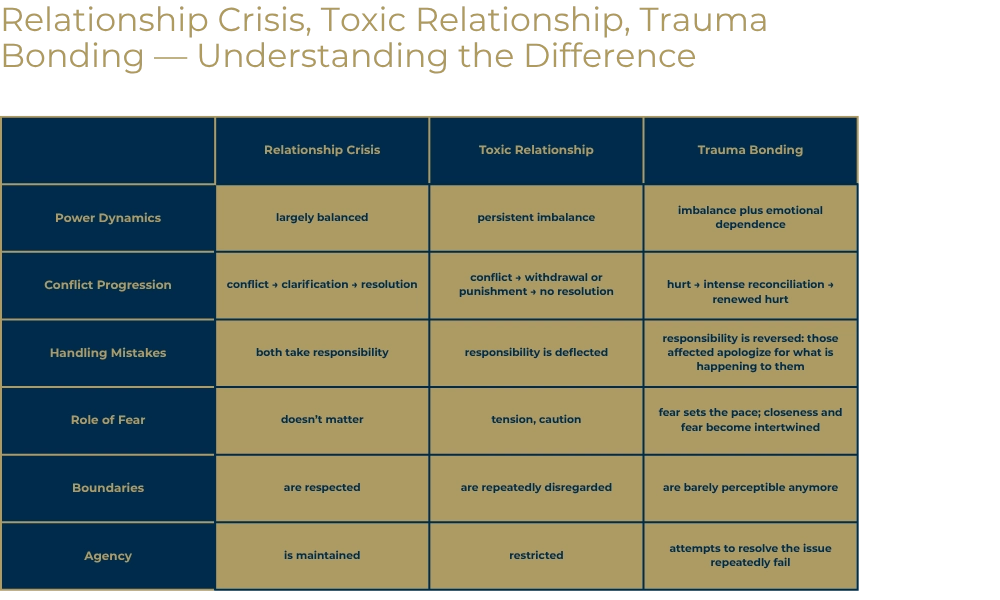
Trauma bonding is often equated with Stockholm syndrome. Whilst the two concepts are related, they are not identical: Stockholm syndrome describes an attachment to the perpetrator in an acute, temporary situation of coercion, such as a hostage-taking. Trauma bonding, by contrast, develops over long periods within a relationship that, from the outside, appears to have been freely chosen. It is also important to distinguish it from co-dependence: the latter centres on maintaining another person’s behaviour, whilst the former centres on the bond formed through the cycle of hurt and reconciliation.
Nor is every conflict-ridden relationship a trauma-based bond. Couples argue, make up and grow through their problems. In healthy relationships, mistakes are acknowledged, responsibility is taken and boundaries are respected. Fair arguments, transparent apologies and tangible changes differ significantly from cycles of shaming, threats and brief idealisation.
How Trauma Bonding Develops: Psychological and Neurobiological Mechanisms
Trauma bonding rarely develops overnight. It often begins with strong idealisation, intense attention and the feeling of finally being truly seen. If insults, belittlement or violence occur later on, it is precisely this initial phase that becomes the inner justification for persevering: because the closeness was experienced as unique, its return seems possible at any time.
This dynamic occurs particularly frequently in relationships with people who display pronounced narcissistic personality traits. The interplay of exaltation and devaluation is structurally embedded in such relationships: affection becomes the currency used to control behaviour. Not every trauma bond has a narcissistic background – but where it is present, the dynamic is usually more pronounced and harder to break free from.
At the same time, persistent stress alters the nervous system’s responsiveness. Hyperarousal – a state of inner alertness, insomnia, constant vigilance – and hypoarousal, characterised by emotional numbness, may alternate. Closeness and fear are thus neurobiologically linked. Early attachment experiences can also influence how people regulate closeness and distance: those who experienced unpredictable care as children may later react more sensitively to similar patterns. This does not imply blame, but rather describes learnt strategies that are unfortunately reinforced in a toxic relationship.
Intermittent Reinforcement: the Effect of Unpredictable Kindness
Psychologically, what is crucial is what is known as intermittent reinforcement: appreciation, affection or apologies occur unpredictably. The brain reacts to this unpredictability with heightened attention and strong anticipation. Rare, unpredictable rewards are significantly more effective in learning processes than reliable ones – they anchor the hope of the next positive phase, even if serious boundary violations occur in the meantime. In behavioural psychology, this is the same mechanism that makes gambling so hard to resist.
Shame, Guilt and Cognitive Dissonance
Feelings of shame and guilt further reinforce the dependency. Those affected wonder whether they are overreacting or whether they themselves are partly to blame for what is happening. At the same time, cognitive dissonance arises: the need for closeness contradicts the experience of being hurt. To make this internal contradiction bearable, the distressing behaviour is downplayed or rationalised, whilst the positive moments are overemphasised. The higher one’s own expectations of ‘making relationships work’, the more strongly this mechanism operates.
Recognising and Interpreting Warning Signs
Warning signs usually develop gradually. Family members often notice changes earlier than those affected themselves – such as social withdrawal, a change in self-esteem or conspicuous justifications. Those affected experience the situation from the inside, wavering between hope and helplessness and wondering whether everything is still within the normal range. The situation becomes critical when boundary violations are not isolated incidents, when fear or pressure dominate communication, and when the relationship noticeably restricts the person’s ability to lead their own life.
Typical Signs of a Traumatic Attachment
A single characteristic does not in itself prove the existence of a trauma-based attachment. What is significant is the repeated interplay of several patterns over a prolonged period:
- Loyalty, despite fear, towards a person who repeatedly belittles, threatens or controls you
- Withdrawal from friendships, family and professional networks
- Keeping incidents secret because ‘it sounds worse to outsiders than it actually is’
- Blame-shifting and gaslighting, until you begin to doubt your own perception
- Cycles of hurt, intense reconciliation, gifts or promises – followed by renewed hurt
- Constantly trying to anticipate the other person’s mood
- Erosion of self-esteem to the point where you no longer recognise yourself
Self-assessment: Questions to Provide Clarity
The following questions are no substitute for a diagnosis. However, they help to highlight patterns that can easily become blurred in everyday life. The more often you agree with the statements, the more worthwhile it is to seek professional advice:
- Do you regularly feel smaller than before after interacting with this person?
- Do you keep incidents to yourself because you fear how those around you might react?
- Do you constantly adjust your behaviour to avoid conflict?
- Do you find the good times so intense that they seem to put everything that came before into perspective?
- Have you already tried several times, in vain, to break away?
- Would you advise a close friend or family member against this relationship?
Effects on the Mind and Body
Ongoing stress of this kind does not go without consequences. The symptoms are real and are not down to a lack of resilience:
- Mental stress Anxiety, depressive moods and inner restlessness are among the most common consequences. In cases of severe or prolonged stress, post-traumatic stress disorders, depression or anxiety disorders may develop.
- Physical symptoms Sleep disturbances, gastrointestinal problems, headaches and muscle tension are common. Chronic stress also impairs concentration and decision-making – often first becoming apparent at work.
- Risky coping strategies Alcohol, medication or other substances are increasingly being used to cope. The transition to substance dependence is a gradual process.
Talk to us – confidentially, with no obligation and without long waiting times.
Ways Out of Trauma-based Attachment
Breaking free from a trauma-based bond is not simply a matter of willpower. Emotionally significant memories, shared commitments, financial or family dependencies, and the hope for change all come into play simultaneously. Added to this is the ingrained habit of downplaying warning signs in order to cope with everyday life. A first, viable focus is therefore not on the big decision, but on stabilisation and safety: gathering information, clarifying one’s own boundaries, and activating one’s support network. This creates room for manoeuvre – and it is only from this that genuine choices arise.
Understanding and Acknowledging Inner Ambivalence
Affection and anger, the need for closeness and fear: conflicting emotions are not the exception but the rule in this dynamic. Taking them seriously, rather than fighting against them, provides inner guidance. It is helpful to make brief, regular notes – what happened, how did I feel, how did others react. When read over a period of weeks, such a record reveals patterns that are barely discernible in the moment.
Safety Comes First
If there is an imminent threat of violence or violence is taking place, protection is the top priority. In acute emergencies, dial the police emergency number 110; for medical emergencies, call the ambulance service on 112. The nationwide helpline ‘Violence against Women’ can be reached on 116 016 24 hours a day, free of charge and anonymously if you wish; the number will not appear on your phone bill. Regardless of any immediate situations, it is wise to make discreet preparations:
- Secure documents Keep copies of your ID, insurance documents, bank details and important contracts in a secure place that is not accessible to others.
- Inform a trusted person Ensure that at least one person outside your immediate circle is aware of the situation and can be contacted in an emergency.
- Keep lines of communication open An alternative means of contact and an agreed code word make it possible to ask for help discreetly.
- Document any incidents Prompt, factual notes support your own account of events and are important should legal action be taken.
After the Break-up: Why the Longing Persists at First
Many people affected are surprised that the longing does not subside after the break-up, but actually intensifies at first. This is not a mistake or a step backwards, but the expected course of events: the nervous system has learnt to associate relief with the other person’s return. The first few weeks therefore often feel like withdrawal – with brooding, sleep disturbances and a highly idealised memory of the good times, whilst the painful ones fade.
During this phase, it is helpful to consistently avoid contact wherever possible, to maintain a clearly structured daily routine, and to have designated people to turn to when the urge to get back together becomes strong. Where shared children, a shared home or an employer prevent a complete break in contact, professional support is particularly worthwhile at an early stage.
Support Services and Professional Help
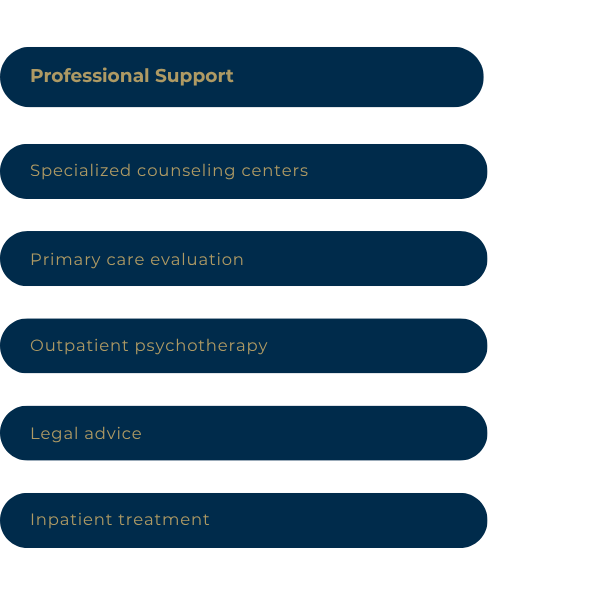
Seeking help does not mean having to decide everything straight away. Counselling and therapeutic sessions initially achieve just one thing: safe options to choose from. Depending on the situation, the following approaches can provide relief:
Treatment Options at the LIMES Schlossklinik Bergisches Land
In cases of severe trauma-related distress, significant exhaustion or co-occurring conditions such as depression, anxiety disorders or post-traumatic stress reactions, inpatient or day-care treatment can be the decisive step. It is not a retreat, but a conscious decision to seek a setting in which it becomes possible to create some distance in the first place. At the LIMES Schlossklinik Bergisches Land, the dynamics of trauma bonding are carefully assessed – without pressuring the patient or trivialising the issue.
The process begins with a comprehensive psychiatric, psychological and psychosomatic assessment, supplemented by a detailed analysis of risks and resources. This forms the basis for a personalised treatment plan that takes physical, psychological and social factors into account. The focus is on safety, stabilising the nervous system and strengthening your ability to take action. Depending on the situation, suitable therapeutic components may include, amongst others:
- Comprehensive assessment and psychoeducation Understanding how intermittent reinforcement works relieves feelings of shame and helps you make sense of your own reactions.
- High-frequency psychotherapy in individual and group settings Sharing experiences with people in similar situations breaks through the isolation that is part of the dynamic.
- Trauma-focused approaches To process distressing memories once sufficient stability has been achieved.
- Schema therapy and ego-state approaches Work on inner parts, coping modes and the attachment patterns underpinning the dynamics.
- Elements of Dialectical Behaviour Therapy (DBT) Managing intense emotions, impulse control and stabilising self-esteem.
- Relaxation therapy and body-oriented techniques Mindfulness and breathing exercises, yoga, qigong and Jacobson’s progressive muscle relaxation help to regulate a nervous system that is in a constant state of alert.
- LIMES Sports.Care A scientifically based, individually tailored training programme, developed in collaboration with stress expert and sports medicine specialist Prof. Dr Uwe Nixdorff.
The treatment is supported by the ‘Healing Environment’ at the Schloss Heiligenhoven site: the architecture, lighting and the surrounding parkland are an integral part of the therapeutic concept. Particularly after a relationship in which constant vigilance became the norm, a place where the nervous system can find peace is more than just a pleasant backdrop. The aim of the treatment goes beyond the alleviation of symptoms: it is about regaining confidence in one’s own judgement and, in future, building relationships from a position of security.
FAQ
How Do I Recognise Trauma Bonding?
Key indicators include a recurring cycle of hurt and intense reconciliation, a growing fear of the other person’s reaction, increasing isolation and a marked decline in self-esteem. A characteristic feature is that you regularly question your own experience and downplay incidents to others. A single characteristic is not enough – what matters is the pattern over months or years. The questions in Chapter 3.2 offer an initial guide, but are no substitute for a professional assessment.
How Do I Break a Trauma Bond?
As a general rule, not on your own and not in a single step. A proven sequence is: first establish safety, then understand the dynamics, and finally work through the underlying patterns. Professional support significantly increases the chances of success, as ambivalence regularly resurfaces during the process of breaking the bond. Setbacks are part of the process and do not indicate failure. Where a complete break in contact is not possible, managing the remaining contact in a sustainable way is part of the treatment objective.
Is Trauma Bonding Only Possible in Romantic Relationships?
No. A traumatic bond can also develop within families, friendships, cult-like groups or hierarchical working relationships – wherever power imbalances, dependency and repeated boundary violations come together. The common thread is always the interplay of closeness and fear, as well as the unpredictable alternation between devaluation and affection.
Please get in touch with us – we’ll advise you in confidence on your options.
Kategorien: Trauma