Somatoform Disorders – When Psychological Stress Manifests Physically
Classification: Understanding Somatoform Disorders
1.1 Common Forms of Somatoform Disorders
1.2 How Is the Diagnosis Made?
How Psychological Stress Manifests Physically: Models and Mechanisms
2.1 Stress Physiology and Perception
2.2 Factors That Perpetuate Symptoms in Everyday Life
Symptoms, Warning Signs and Distinctions
3.1 Typical Symptoms
3.2 When to Seek Medical Advice?
3.3 Distinction From Other Disorders
Everyday Life, Work and Social Consequences
4.1 Working Whilst Experiencing Symptoms: Realistic Steps
4.2 Involving Family Members – Providing Helpful Support
5.1 Psychotherapeutic Approaches
5.2 Complementary Specialist Therapies and LIMES Sports.Care
5.3 Medication and Medical Support
5.4 Admission, Course of Treatment and Objectives
6.1 How Do I Distinguish a Somatoform Disorder From an as Yet Undiagnosed Physical Illness?
6.2 Can a Somatoform Disorder Render a Person Unfit for Work – and for How Long?
6.3 What Are Somatoform Disorders in Children and Adolescents – Are There Any Specific Features?
Classification: Understanding Somatoform Disorders
Many people experience physical symptoms for which no clear organic cause can initially be found. If such symptoms are persistent, cause significant distress and are accompanied by marked anxiety or impairment, a somatoform disorder may be present. This refers to a group of mental health conditions in which psychological stress, strain or unfavourable attention and evaluation processes contribute significantly to the development and persistence of the symptoms – often without a purely organic explanation being sufficient on its own.
Many people affected ask themselves: what exactly are somatoform disorders? Medically speaking, they constitute a distinct clinical entity – not an ‘imaginary illness’. The symptoms are real and can be highly debilitating. Depending on the classification, subtypes include, amongst others, somatisation disorder, persistent somatoform pain disorder and hypochondriacal disorder. Current classifications place particular emphasis on a positive diagnosis: the key is not to completely rule out every physical cause, but to recognise typical psychological and behavioural patterns alongside a thorough medical assessment.
Common Forms of Somatoform Disorders
Somatoform disorders manifest in various ways. The exact classification is determined on a case-by-case basis and is guided by clinical guidelines as well as medical and psychotherapeutic diagnosis. The following examples provide an overview of common variants, without claiming to be exhaustive, according to ICD-10 F45.
- Somatisation disorder
A wide range of physical symptoms, often changing, affecting various organ systems over a prolonged period, accompanied by significant impairment and distress. - Persistent somatoform pain disorder
Pain is the predominant symptom; it is significantly influenced by psychological factors and often becomes chronic. - Hypochondriacal disorder / fear of illness
Intense fear of a serious illness, despite repeated reassurances from doctors; attention is strongly focused on bodily signals. - Undifferentiated somatoform disorder
The predominance of individual, not fully explainable symptoms over a prolonged period, associated with distress and impairment.
How Is the Diagnosis Made?
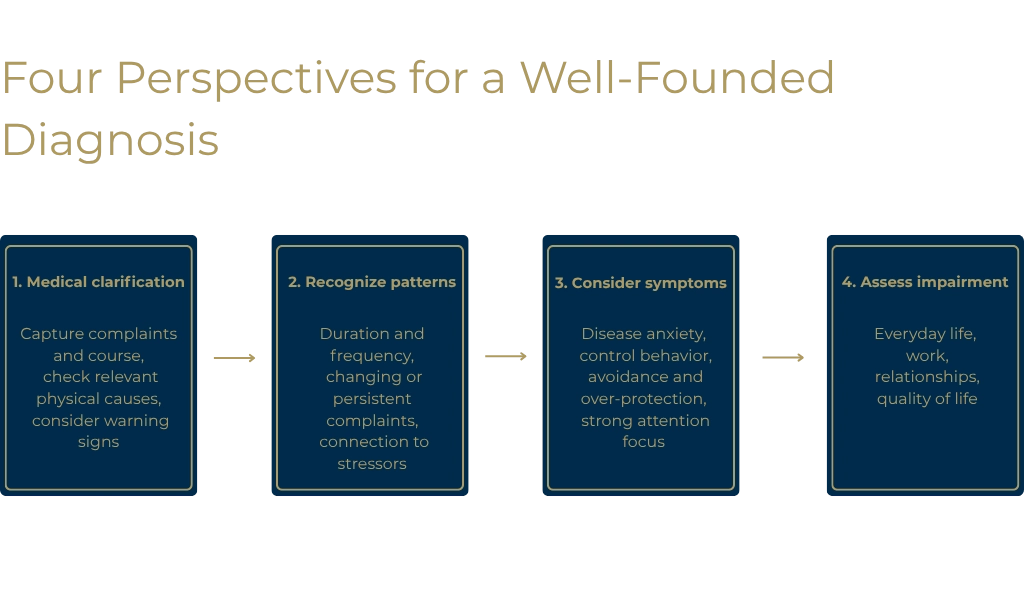
The diagnostic process is a step-by-step, interdisciplinary one. The first priority is a thorough medical history: what symptoms are present, since when, in what situations do they occur, what previous treatments have been undertaken, and what impact do they have on everyday life? At the same time, an assessment is made of which medical examinations have already been carried out and whether further somatic investigations are warranted.
At the same time, doctors and psychotherapists pay attention to psychological factors that may exacerbate symptoms – including persistent health concerns, avoidance behaviour, an excessive focus on bodily signals, or high levels of stress. The aim is to carry out a meaningful basic medical assessment without endless diagnostic loops, supplemented by a psychological evaluation of the level of anxiety, beliefs about the illness and coping strategies. It is also crucial to consider specific impairments in daily life, at work and in social life, as well as to provide clear, unbiased information without trivialising the symptoms. In practice, this leads to a positive – that is, substantively justified – diagnosis of a somatoform disorder.
Do you suspect a somatoform disorder? Please feel free to get in touch – we’re here for you.
How Psychological Stress Manifests Physically: Models and Mechanisms
Somatoform disorders can be understood through the interplay of biological, psychological and social factors. Stress activates the autonomic nervous system and stress hormone systems; body perception may change, pain is perceived more acutely, and harmless bodily signals take on a threatening significance. This intensifies worry, self-restraint and further tension – a cycle that can perpetuate symptoms.
It is important to note that this process is not a conscious one. It is an expression of learning- and stress-related biological mechanisms that, in principle, are at work in all people, but become more pronounced during difficult phases of life. A somatoform disorder usually does not arise ‘overnight’, but develops gradually during periods of stress, illness, excessive demands or following stressful life events.
Stress Physiology and Perception
Under stress, adrenaline, noradrenaline and cortisol are released. Heart rate, breathing and muscle tension increase – reactions which are, in themselves, sensible. However, when stress becomes chronic, the nervous system’s processing of stimuli can become more sensitive. Physical signals are perceived as more intense and unpleasant; thoughts such as ‘This is a dangerous sign’ intensify the anxiety.
Those who repeatedly and anxiously focus on their bodies notice more – which further heightens their perception of symptoms. Interpreting these signals as ‘dangerous’ intensifies tension and encourages avoidance behaviour. Taking it easy, withdrawing and frequent checks may provide short-term relief, but in the long term they tend to stabilise the symptoms rather than counteract them.
Factors That Perpetuate Symptoms in Everyday Life
Alongside biological processes, habits and contextual factors play an important role. Many affected individuals report that uncertainty about the cause, conflicting information or repeated, poorly targeted investigations intensify their worry. Constant diagnostic testing without a clear result – the so-called ‘medical odyssey’ – can increase uncertainty rather than resolve it. Avoiding activities out of fear of a deterioration also reduces quality of life and physical resilience. Persistent pressure to perform, conflicts or lack of sleep further increase physical tension. Those who allow little leeway for bodily reactions – for example, due to perfectionism or high self-expectations – are quick to interpret normal fluctuations as threatening.
Symptoms, Warning Signs and Distinctions
The symptoms of somatoform disorders can vary greatly. They usually persist for weeks to months, and sometimes even years, leading to difficulties in daily life, at work and in social situations. Typical symptoms include pain, cardiovascular or gastrointestinal problems, dizziness or exhaustion.
At the same time, it is important to note that the symptoms of somatoform disorders often overlap with those of other conditions. A basic medical assessment is therefore essential before a diagnosis is made. The key factors in classification are the interplay between the duration of symptoms, the degree of impairment, health anxiety and the way in which the symptoms are managed.
Typical Symptoms
The following examples illustrate how varied somatoform disorders can be. Not all symptoms need to be present; their severity varies from person to person. If you recognise yourself in these descriptions, it may be helpful to have the situation assessed by a doctor and a psychotherapist.
- Pain
Headaches, back pain, muscle pain or joint pain, often varying in nature or without a clear trigger. - Gastrointestinal
Nausea, bloating, abdominal pain, irritable bowel symptoms, difficulty swallowing. - Cardiovascular and Respiratory
Palpitations, tightness in the chest, shortness of breath without any lung or heart abnormalities, dizziness. - Neurological symptoms
Tingling, numbness, weakness, functional paralysis or unsteadiness when walking. - General symptoms
Severe tiredness, exhaustion, sleep disturbances, sensitivity to temperature and pain.
It is important not just to look at individual symptoms, but at the overall pattern: the duration, the distress caused, the worries and how the symptoms are managed.
When to Seek Medical Advice?
A thorough medical assessment provides reassurance and prevents treatable organic causes from being overlooked. Often, a structured basic diagnostic assessment is sufficient. In many cases, a joint approach involving your GP and a psychotherapist is worthwhile to avoid duplicate tests and to develop a clear plan.
Regardless of whether a somatoform disorder is present, you should seek medical advice promptly if new, rapidly worsening or alarming symptoms arise. Depending on the context, warning signs may include: sudden onset of unusually severe pain, disturbances of consciousness, signs of paralysis, blood in the stools, persistent fever or unintentional, significant weight loss. If you have a known pre-existing condition or are experiencing new, severe symptoms, the general rule is: seek medical advice.
Get in touch now – we will support you confidentially and as equals on your journey to recovery.
Distinction From Other Disorders
Somatoform disorders overlap in symptoms with anxiety and depressive disorders, post-traumatic stress disorders or functional physical symptoms such as irritable bowel syndrome or fibromyalgia. Comorbidities are common. When it comes to treatment, it is not so much the label that matters as a shared understanding of the mechanisms that perpetuate the symptoms.
Somatisation disorder has traditionally been defined as a broad pattern of physical symptoms; more recent diagnostic systems place greater emphasis on the distress caused by symptoms and illness-related thoughts. A precise diagnosis is made during an individual consultation and may be adjusted over time.
Everyday Life, Work and Social Consequences
Somatoform disorders affect not only the body but also shape relationships, leisure activities and work. Unpredictable flare-ups of symptoms, doctor’s appointments and exhaustion can dictate the daily routine. It is not uncommon for a conflict to arise between the desire to ‘function normally’ and the worry that being active might make things worse.
A common question is: Does a somatoform disorder render a person unfit for work? Depending on the severity, it may be necessary to take temporary sick leave – for example, in the event of a heavy symptom burden or during an acute phase of treatment. However, the aim is usually a gradual return to manageable levels of activity. Whether, and to what extent, a somatoform disorder renders a person unable to work depends on the severity of symptoms, the nature of the job, comorbid conditions and the support services available.
Working Whilst Experiencing Symptoms: Realistic Steps
A structured approach to work can help to avoid becoming overwhelmed and to regain a sense of self-efficacy. It is important to take medical advice into account and to find individual solutions.
- Gradual return to normal activities
In consultation with a doctor, a gradual increase in workload; clear, achievable interim goals. - Workplace adjustments
Ergonomic measures, clear rules on breaks, opportunities for short rest periods. - Transparency as required
Consider who you would like to speak to and to what extent (company doctor, HR department) – your right to confidentiality is safeguarded. - Routines and self-care
Fixed times for meals, sleep and exercise help stabilise your day-night rhythm and reduce stress.
Involving Family Members – Providing Helpful Support
Somatoform disorders are often difficult for family members to understand. It is helpful to take symptoms seriously without dramatising them – validation without overemphasising them builds trust. At the same time, it is worth encouraging joint engagement: small, regular steps rather than an ‘all or nothing’ approach. It is important to maintain a clear sense of one’s own role – to provide support without reinforcing the person’s tendency to seek control or avoid situations. Joint appointments or facilitated discussions can help to strike this balance.
Find out now about the admission process – discreet, straightforward and with no long waiting times.
Treatment: Proven Therapeutic Approaches and the Services Offered by the Limes Schlossklinik Bergisches Land
The treatment of somatoform disorders aims to break the vicious circle of anxiety, tension, symptom-focus and avoidance. At the LIMES Schlossklinik Bergisches Land, somatoform disorders are treated holistically – with thorough diagnosis, individualised treatment planning and a multimodal approach that takes physical and psychological factors equally into account. The aim is to gain confidence in managing symptoms and, step by step, to regain a sense of activity and quality of life.
Depending on the clinical presentation, cognitive behavioural therapy, psychodynamically based methods, mindfulness-based approaches, pain therapy and body-oriented techniques may be considered. In cases of significant comorbidities such as depression or anxiety disorders , medication may be used to support treatment – following medical assessment. Particular emphasis is placed on psychoeducation, building up activity levels, reducing health-related anxiety and strengthening self-efficacy. Where necessary, family members are involved – for example, in couple or family counselling sessions.
Psychotherapeutic Approaches
Psychotherapy helps patients understand the mechanisms that exacerbate their symptoms and explore new strategies. At the LIMES Schlossklinik Bergisches Land , this is achieved through frequent individual and group therapy – using cognitive-behavioural, psychodynamic and mindfulness-based approaches. The content is tailored to the individual; the following elements frequently feature in effective treatment plans.
- Psychoeducation
Explaining in simple terms how stress, perception and evaluation influence symptoms – the basis for change. - Cognitive techniques
Recognising, examining and evaluating health-related fears and cycles of rumination in a more flexible way. - Gradual progression rather than rest
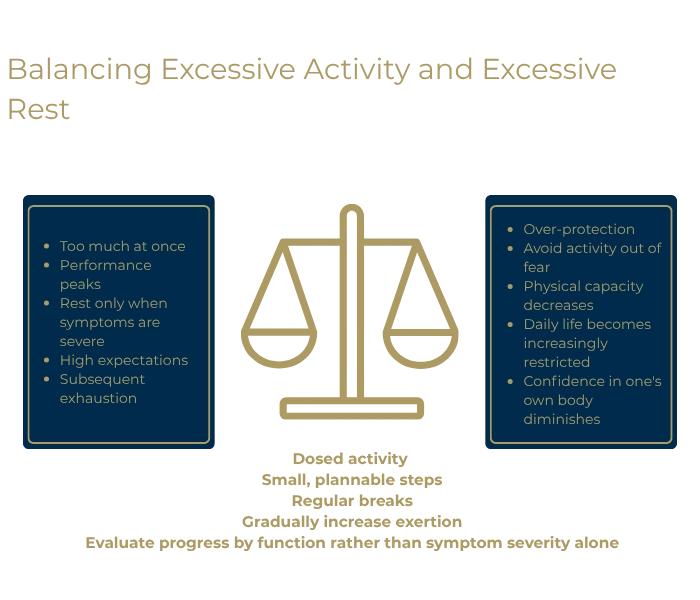
Guided gradual increase in activity (pacing), interval training and real-life exposure whilst paying attention to the body’s signals. - Mindfulness and body awareness
Non-judgemental awareness of signals reduces alarm and reactivity. - Dealing with relapses
Recognising early warning signs, developing contingency plans and strengthening resources.
Complementary Specialist Therapies and Limes Sports.care
In addition to psychotherapy, the treatment plan at the LIMES Schlossklinik includes a wide range of body- and resource-oriented approaches. Relaxation therapy, mindfulness and breathing exercises, yoga, qigong and progressive muscle relaxation according to Jacobson help to regulate tension and develop a new body awareness. Art, dance and movement therapy, as well as occupational and physiotherapy, promote body awareness and support gradual reactivation in everyday life.
A special feature is LIMES Sports.Care – a scientifically grounded, individually tailored rehabilitation programme developed in collaboration with stress expert and sports medicine specialist Prof. Dr Uwe Nixdorff. Sport not only strengthens the body but has also been proven to have a positive effect on mood, stress tolerance and self-efficacy – making it a key component in the treatment of somatoform disorders.
Medication and Medical Support
Medication is not the first line of treatment, but may be appropriate in cases of comorbid conditions (e.g. depression, anxiety) or chronic pain. The decision is made on a case-by-case basis and only following a thorough diagnostic assessment – always weighing up the benefits and risks. Repeated, stressful diagnostic tests without a treatment plan should be avoided wherever possible.
- Antidepressants
Can improve responsiveness to treatment in cases of comorbid depression or anxiety; the time taken for the medication to take effect and any side effects are discussed realistically. - Pain management
Multimodal rather than purely pharmacological; cautious use of analgesics, avoiding unnecessary opioids. - Sleep and lifestyle
Sleep hygiene, regular exercise and a structured daily routine are often effective components.
Admission, Course of Treatment and Objectives
At the start of your stay, you will undergo a comprehensive psychiatric, psychological and psychosomatic assessment, including a structured medical history and the joint setting of treatment goals. The course of treatment is regularly reviewed and adjusted. Key objectives include: understanding symptoms and triggers, gaining confidence in interpreting bodily signals, increasing activity levels, establishing relapse prevention strategies and, in the long term, enhancing your ability to participate in the world of work.
FAQ
How Do I Distinguish a Somatoform Disorder From an as yet Undiagnosed Physical Illness?
The distinction is never made on the basis of a single symptom alone. A structured initial medical assessment and the overall picture are important: the duration and variety of symptoms, the extent of health-related concerns, the functional impact on daily life and work, and the way in which the symptoms are managed. In somatoform disorders, cognitive processes, attention and stress play a key role. If, despite appropriate investigations, no adequate physical explanation can be found and psychological factors are clearly involved, the diagnosis can be made. Treatment is then targeted at the mechanisms perpetuating the condition – whilst at the same time promoting healthy lifestyle habits.
Can a Somatoform Disorder Render a Person Unfit for Work – and for How Long?
Depending on the severity, a somatoform disorder can render a person unable to work, for example in cases of severe pain, exhaustion or intense fear of illness. The duration varies from person to person and depends on the burden of symptoms, the nature of the work, any comorbid conditions and the treatment. The aim is often a gradual return to work in order to build up functional capacity in the long term. An early, structured treatment plan increases the chances of a quicker return to coping with the demands of daily life and work.
What Are Somatoform Disorders in Children and Adolescents – Are There Any Specific Features?
Somatoform symptoms can also occur during adolescence, often in the form of abdominal pain, headaches, dizziness or exhaustion. School-related stress, family pressures and developmental challenges play a role. Diagnosis and treatment usually involve the family, assess the school environment and take a resource-oriented approach. The principles are similar to those for treating adults: psychoeducation, gradual increase in activity, stress management and controlled exposure to physical symptoms.
Many people affected still ask themselves: What do somatoform disorders mean in my specific case? A personal assessment helps you find your own individual path – without time pressure and with a clear treatment plan.
Kategorien: Somatoform Disorders