Pathological Perfectionism – When The Pressure Takes Its Toll
Table of Contents
- Pathological Perfectionism: When High Standards Take Their Toll
- Pathological Perfectionism: Symptoms, Warning Signs and How It Differs From Other Conditions
- Cognitive-emotional Signs
- Behavioural and Physical Signs
- Overlap With Mental Health Conditions
- Perfectionism: Causes in Childhood, Personality and Environment
- Influences From Childhood and Adolescence
- Personality, Thought Patterns and a Culture of High Achievement
- Anxiety and Perfectionism: a Vicious Circle of Rumination and Control
- Compulsive Rumination: When the Thinking Won’t Stop
- Avoidance, Procrastination and Over-control
- Effects on Work, Relationships and Health
- Letting Go of Perfectionism: What Is Realistic in Everyday Life
- Treatment Options at the LIMES Schlossklinik Bergisches Land
- FAQs
- Is Perfectionism Always Problematic, or Can It Also Be Protective?
- How Can I Tell If My Perfectionism Masks a Disorder That Requires Treatment?
- Can I Overcome Perfectionism Without Compromising My Performance?
Pathological Perfectionism: When High Standards Take Their Toll
Diligence, reliability and high standards are strengths. They enable responsibility, quality and professional success – and many people who possess these qualities have gone far in life. It only becomes problematic when one’s internal standards become relentless: when mistakes are experienced as a catastrophe, when one’s self-esteem depends almost exclusively on flawless performance, and when no result is ever good enough. The term ‘pathological perfectionism’ has become established to describe this pattern.
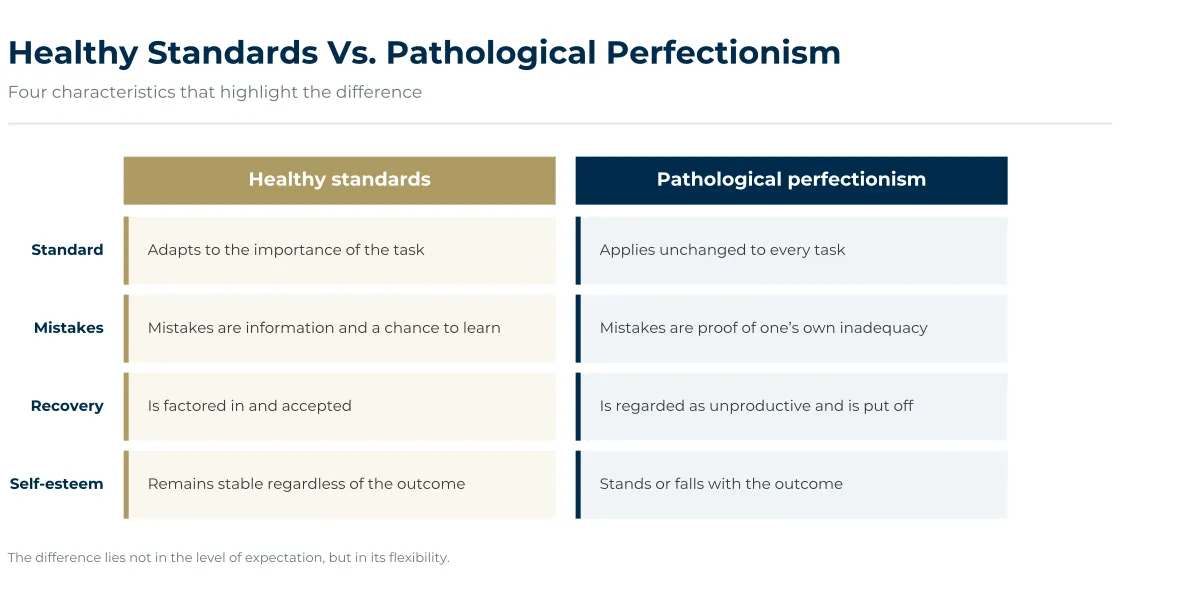
The key distinction lies between a healthy drive for achievement and a rigid, anxiety-driven one. A healthy drive is flexible: it adapts to the situation, allows for rest and can tolerate criticism. Pathological perfectionism, on the other hand, is rigid and linked to intense self-criticism. Four characteristics help to classify it:
- The standard applies regardless of how important a task actually is.
- Successes are downplayed internally, whilst mistakes are dwelled upon at length.
- Rest is seen as unproductive and is therefore put off.
- The effort increases, yet the result never feels good enough.
Depending on its severity, this pattern may be distressing in its own right or may be associated with conditions requiring treatment – frequently with anxiety disorders, depression or obsessive-compulsive disorder.
Pathological Perfectionism: Symptoms, Warning Signs and How It Differs From Other Conditions
The symptoms of pathological perfectionism manifest themselves on several levels simultaneously: in thoughts, feelings, behaviour and the body. Typical characteristics include rigid ‘all-or-nothing’ standards, a pronounced fear of making mistakes and a strong need for control. Many people affected report never being satisfied despite their best efforts: the process of making corrections takes up more and more time, whilst exhaustion sets in.
Cognitive-emotional Signs
Thoughts are dominated by high standards and the fear that even minor mistakes could have serious consequences. Persistent, non-solution-oriented rumination sustains the internal pressure. Tension, anxiety or feelings of guilt intensify whenever demands are not fully met.
- Strict internal rules such as ‘I must not make any mistakes’
- Black-and-white thinking, which makes flexible decision-making difficult
- Catastrophic interpretations of minor deviations
- Self-worth that is almost entirely tied to results
- Praise that only provides brief relief, whilst criticism lingers for a long time
Behavioural and Physical Signs
Behaviourally, the most notable feature is a tendency to work on tasks beyond what is reasonable. Some people avoid tasks altogether as soon as they fear they will not meet their own standards. Physically, persistent tension is often the first sign to appear.
- Endless cycles of correction
Revising, checking and rearranging create time pressure and drain reserves without significantly improving the result. - Procrastination due to fear of making mistakes
The start is postponed until everything seems perfectly prepared – which only increases the pressure further. - Physical signs of stress
Muscle tension, headaches, gastrointestinal problems and sleep disorders often accompany the persistent tension for months on end.
Overlap With Mental Health Conditions
Not every high standard requires treatment, and not every stress-related low is depression. At the same time, pronounced perfectionism is a factor that can contribute to the development and persistence of a range of conditions. The following classification is no substitute for a diagnosis, but it highlights typical points of overlap:
- Anxiety disorders
Worries, tension and avoidance overlap with generalised anxiety; fears and perfectionism reinforce one another in the process. - Obsessive-compulsive disorder
Pronounced checking behaviour and rigid rituals may indicate obsessive-compulsive symptoms, particularly in the case of time-consuming compulsive actions or thoughts. - Depression and burnout
Constant self-criticism, exhaustion and withdrawal often lead to the development of depression – a typical symptom is the feeling of never being good enough. - Eating disorders
If the need for control is directed towards the body and food, weight management can become rigid and harmful to health.
Perfectionism: Causes in Childhood, Personality and Environment
The development of perfectionism is generally multifactorial. Genetic predisposition, early learning experiences, societal expectations of achievement and current stressors all interplay. Often, these patterns develop gradually and become entrenched over the years – through both experiences of success and avoidance.
Influences From Childhood and Adolescence
When it comes to perfectionism, the cause is often first sought in childhood, and indeed, early experiences of attachment and achievement frequently play a role. Children learn at an early age what earns them recognition and how mistakes are dealt with in their environment. If appreciation is predominantly linked to achievement, or if criticism is frequent and harsh, the belief can become entrenched: ‘I am only good enough if I don’t make mistakes.’
Equally formative is the way adults deal with their own mistakes. If these are handled openly and constructively, children come to see errors as part of development. If, on the other hand, mistakes are dramatised or concealed, this can easily lead to feelings of shame and strict self-imposed rules. In therapy and psychoeducation, this connection is therefore regularly addressed – not to assign blame, but to help make current patterns understandable.
Personality, Thought Patterns and a Culture of High Achievement
High standards of order and precision, combined with a strong sense of responsibility, initially have a positive effect in everyday life. Under sustained pressure, however, this can more easily tip over into over-control. Added to this are thought patterns such as catastrophising and excessive ‘should’ statements, which intensify anxiety and perpetuate avoidant behaviour. Factors from the environment have a reinforcing effect:
- Performance-oriented corporate cultures with constant comparison
- Professions with low tolerance for error, such as in medicine, law or finance
- Leadership roles involving frequent decision-making and high visibility
- Constant digital assessment and self-presentation on social media
- Multiple private pressures that further reduce opportunities for rest
- A lack of a feedback culture, where uncertainty is offset by working overtime
Conversely, teams that learn from mistakes, set realistic goals and foster psychological safety have a protective effect.
Anxiety and Perfectionism: a Vicious Circle of Rumination and Control
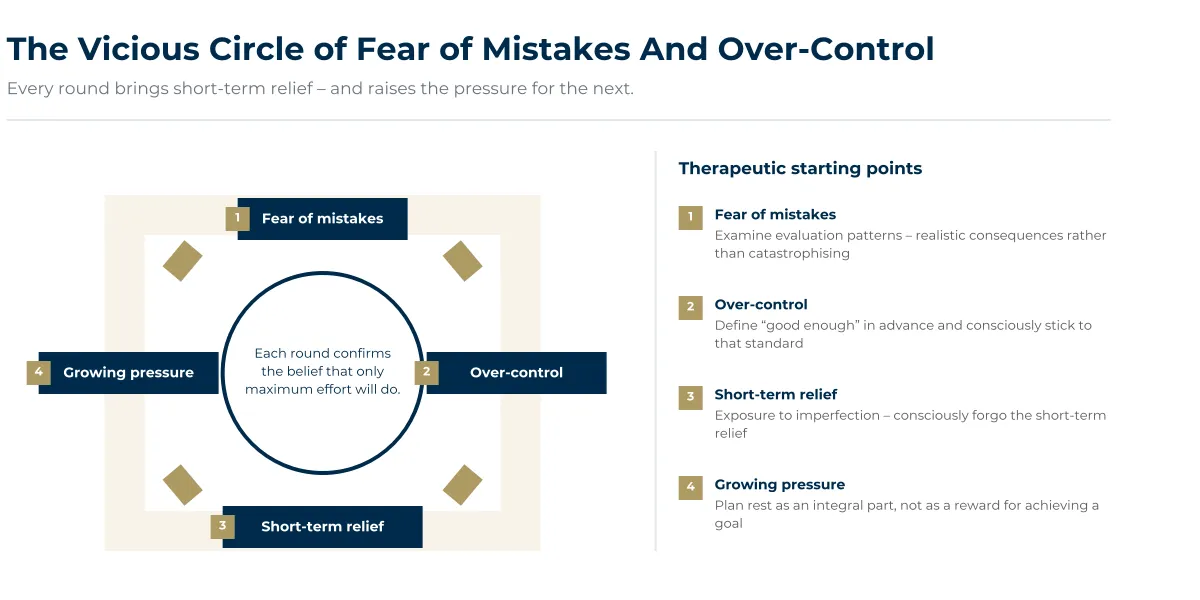
Anxiety and perfectionism often reinforce each other. The fear of making mistakes or facing criticism leads to taking excessive precautions when carrying out tasks. In the short term, this reduces tension – but in the long term, this behaviour reinforces the belief that nothing can be achieved without maximum effort. This creates a cycle of worry, control and growing exhaustion, accompanied by an inner dialogue of self-criticism and self-driven statements.
Compulsive Rumination: When the Thinking Won’t Stop
Compulsive rumination refers to persistent, repetitive thinking that does not lead to a decision or solution. It differs from careful planning in that it goes round in circles rather than providing structure. The past is over-analysed, whilst future eventualities are sought to be controlled in advance. This increases tension, delays action and intensifies the fear of making mistakes.
- Planning gradually reduces uncertainty, whilst rumination perpetuates it and makes it worse.
- In the evenings and at night, these ruminating thoughts often intensify and disrupt sleep.
- If this persists for weeks and interferes with daily life, it is advisable to seek professional assessment.
Avoidance, Procrastination and Over-control
Perfectionist anxiety can lead in two opposite directions. Either the start is postponed until everything seems perfectly prepared – or the task veers into excessive control with endless cycles of correction. Both reactions provide short-term relief but, in the long term, reinforce insecurity and self-doubt.
Effects on Work, Relationships and Health
At work, the consequences first manifest as overtime, delayed decisions and conflicts arising from a failure to delegate – handing over tasks is difficult when only one’s own execution is considered reliable. In relationships, closeness and spontaneity take a back seat to expectations and planning; loved ones often find that high expectations are also directed at themselves. Physically, tension, lack of sleep and a lack of rest accumulate over months. Many of those affected continue to function outwardly without arousing suspicion for a long time, whilst their inner reserves dwindle. It is precisely this ability to carry on that delays the moment when they seek support.
Letting Go of Perfectionism: What Is Realistic in Everyday Life
Many people affected wonder whether they can let go of their perfectionism. Realistically speaking, the tendency towards precision and high standards usually remains part of one’s personality – but the distressing, rigid aspect can be effectively managed. The aim is not carelessness, but a flexible, context-appropriate focus on quality that allows room for rest and self-compassion. Everyday strategies can prepare the ground for this and support it, but they do not replace therapeutic work. A step-by-step approach is crucial: it is not about letting go of everything, but about becoming more flexible.
- Define ‘good enough’ in advance
Decide when a task has been completed sufficiently, and consciously stick to this standard – even when the urge to do a bit more arises. - Limit rumination
Clear time slots and a note-taking technique help channel ruminative thoughts; outstanding issues are listed, prioritised and broken down into manageable steps. - Practise dealing with mistakes
Deliberately allow for minor imperfections and assess the actual consequences – they are almost always less severe than feared.
Professional support is particularly advisable if symptoms persist or worsen, if your ability to function at work, in your studies or in relationships declines significantly, or if you feel hopeless and overwhelmed.
Treatment Options at the LIMES Schlossklinik Bergisches Land
At the LIMES Schlossklinik Bergisches Land, treatment begins with a comprehensive psychiatric, psychological and psychosomatic assessment. This clarifies the severity of the perfectionist pattern, identifies the triggers and maintaining factors at play, and determines whether comorbid conditions such as anxiety disorders, depression or obsessive-compulsive disorder are present. This forms the basis for an individualised treatment plan.
Depending on the severity, outpatient measures may suffice; in cases of pronounced symptoms or relevant comorbidities, more intensive inpatient treatment is advisable. The approaches that work are those combining psychoeducation, recognising one’s own triggers, and changing patterns of thought and behaviour. With us, body-based and creative therapeutic approaches complement frequent psychotherapy sessions, and a structured daily routine supports stabilisation, recovery and the transition back to everyday life. Depending on the situation, suitable therapeutic components may include, amongst others:
- Comprehensive assessment and psychoeducation
These help you understand how anxiety and perfectionism interact, and lay the foundation for tailored therapeutic goals. - High-frequency psychotherapy in individual and group settings
Regular one-to-one sessions are complemented by group sessions, which are particularly effective for addressing performance expectations and self-assessment. - Cognitive behavioural therapy
Rigid standards are re-evaluated, alternatives are developed and tested in practical exercises – for example, by consciously completing tasks to a ‘good enough’ standard. - Schema therapy, metacognitive and acceptance-based approaches
Early performance schemas and harsh inner critics are addressed, compulsive rumination is interrupted and value-guided behaviour is reinforced despite uncertainty. - Exposure to imperfection
Deliberate mistakes and decision-making exercises increase tolerance of residual uncertainty and reduce over-control. - Relaxation therapy with mindfulness and breathing exercises
Supplemented by Jacobson’s progressive muscle relaxation, yoga and qigong, these techniques reduce chronic physical tension. - Dance, movement, art and occupational therapy
Creative approaches open up avenues beyond judgement and outcomes – an effective counterbalance to rigid pressure to perform. - LIMES Sports.Care
A personalised training programme, developed in collaboration with stress expert and sports physician Prof. Dr Uwe Nixdorff, which restores a healthy balance between exertion and recovery. - Pharmacotherapy and somatic co-treatment
If there are additional depressive or pronounced anxiety symptoms, medication may be considered following a thorough diagnosis; this decision must always be made by a doctor and is closely monitored. - Support for relatives and aftercare
Couples’ and family counselling sessions help to change expectations and communication patterns; aftercare planning ensures that the progress made is maintained in everyday life.
The treatment is supported by the ‘Healing Environment’ at the Schloss Heiligenhoven site: the architecture, lighting and the surrounding parkland are an integral part of the therapeutic concept. The aim of the treatment goes beyond the reduction of individual symptoms. The focus is on maintaining care and high standards as strengths, whilst at the same time developing a sustainable, long-term approach to dealing with mistakes, recovery and one’s own limits.
FAQs
Is Perfectionism Always Problematic, or Can It Also Be Protective?
High standards of quality are sensible and promote performance, as long as they remain flexible and allow for rest, delegation and tolerance of mistakes. It becomes problematic when these standards become rigid, self-worth depends almost exclusively on performance, and significant limitations arise in everyday life. In such cases, professional support can help to preserve the healthy aspects and change the distressing patterns.
How Can I Tell If My Perfectionism Masks a Disorder That Requires Treatment?
Warning signs include persistent, compulsive rumination, a pronounced fear of making mistakes, social withdrawal, sleep problems, exhaustion, or the feeling that you can barely bring yourself to start tasks for fear of inadequacy. If these signs persist for weeks or become more severe, it is advisable to seek professional assessment – for example, at your GP’s surgery, a psychotherapy practice or a specialist clinic.
Can I Overcome Perfectionism Without Compromising My Performance?
Yes. The aim is not to abandon diligence, but to relieve the rigid pressure and develop a flexible approach to quality that is appropriate to the situation. Many patients report that, following therapeutic work, they find it easier to make decisions and are better able to allow themselves to relax. Performance remains intact – in fact, it often improves because over-control, rumination and avoidance decrease.
Kategorien: Obsessive-Compulsive Disorders

