High-functioning Depression – When Success Masks The Suffering
Table of Contents
Understanding the Term: What Does ‘high-functioning Depression’ Actually Mean?
1.1 What Is High-functioning Depression?
1.2 Depression: Definition and Distinction From Mood Swings
How Can High-functioning Depression Be Recognised?
2.1 Key Symptoms in One’s Inner Life
2.2 Everyday Signs Despite Maintaining Performance
2.3 Warning Signs for Family Members
Background, Definition and Progression
3.1 Risk Factors
3.2 Distinction From Burnout and Anxiety Disorders
3.3 Double Depression and the Urgent Need for Action
What Helps in Everyday Life – and What Are the Limits of Self-help?
4.1 First Steps in Self-care
4.2 Speaking Openly and Recognising Boundaries
Treatment at the Limes Schlossklinik Bergisches Land
6.1 Is High-functioning Depression Less ‘serious’ Than Other Forms of the Condition?
6.2 How Do I Raise the Subject With My Gp or at a Surgery?
6.3 Can I Carry on Working Whilst Undergoing Treatment – or Is a Break Necessary?
Understanding the Term: What Does ‘high-functioning Depression’ Actually Mean?
Many people appear resilient, organised and successful on the outside – yet internally they struggle daily with low mood, a lack of motivation or self-doubt. This situation is colloquially referred to as high-functioning depression. The term describes people who, despite significant depressive symptoms, continue to ‘function’ in everyday life over a prolonged period, performing their duties and shouldering responsibilities.
It is important to note the technical classification: high-functioning depression is not an official diagnosis in ICD-10/ICD-11 or DSM-5. Rather, it is a description of a course or presentation within the context of depressive disorders. What is decisive is not outward success, but the inner distress and the question of whether criteria for a condition requiring treatment are met depression that requires treatment are met. A thorough assessment helps to distinguish between temporary mood dips and a clinically significant disorder.
1.1 What Is High-functioning Depression?
If you are wondering what ‘high-functioning depression’ is, it can be outlined as follows: those affected experience typical depressive symptoms such as low mood, loss of interest or exhaustion, yet at the same time continue to fulfil their professional or personal obligations. They often display perfectionist tendencies, a strong sense of duty and a powerful drive to achieve – characteristics that project an image of stability to the outside world, but which take a heavy toll on them internally.
Clinically, such symptoms may correspond to a mild to moderate depressive episode or manifest as part of a persistent depressive disorder (dysthymia). In some cases, a chronically low mood may develop into an episode characterised by a marked deterioration – known as ‘double depression’. Regardless of the term used, the following applies: if psychological distress, impairment and duration increase, a professional assessment is advisable.
1.2 Depression: Definition and Distinction From Mood Swings
In technical terms, we refer to a depressive disorder when several core symptoms occur over a period of at least two weeks – such as a persistently low mood, loss of interest and reduced drive, often accompanied by sleep disturbances, difficulty concentrating, feelings of guilt or physical complaints with no organic cause. The severity and duration vary from case to case.
It must be distinguished from normal mood swings or reactions to stressful events. A temporary low mood following periods of stress is not automatically depression. The decisive factors are the frequency, intensity and impact on daily life of the symptoms. In the case of high-functioning depression, this impact on daily life may sometimes be concealed from the outside world – yet the inner severity often differs little from ‘visible’ cases.
How Can High-functioning Depression Be Recognised?
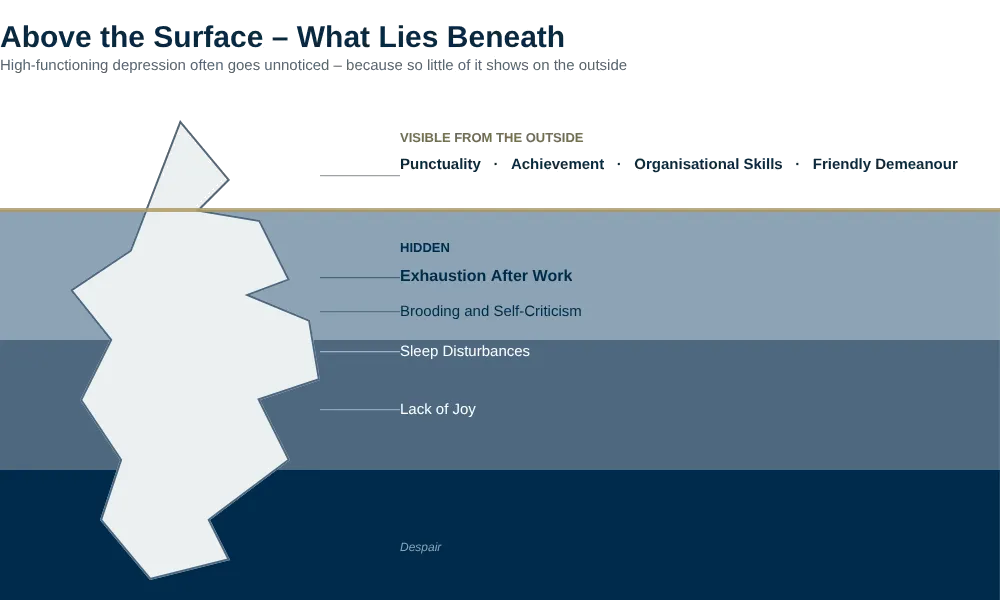
Because those affected continue to carry out tasks, keep to appointments and perform well, the symptoms are often overlooked – even by the sufferers themselves. This ‘functioning’ frequently serves as supposed evidence that they are not seriously ill. At the same time, the body and mind send out clear warning signals, particularly during periods without external pressure.
A characteristic feature is the discrepancy between one’s external role and inner experience. Many describe feeling as though they are wearing a sort of mask: confident during the day, exhausted and empty in the evening. This is precisely where the risk lies of recognising symptoms requiring treatment too late and enduring them for an unnecessarily long time.
2.1 Key Symptoms in One’s Inner Life
The symptoms often primarily affect one’s inner experience. They manifest more subtly but persistently and, over time, cause considerable distress:
- Persistent inner despondency or emotional numbness, even when everyday life is ‘running smoothly’
- Reduced interest and loss of pleasure: things that used to motivate now seem dull or pointless
- Increased fatigue and lack of drive, particularly after work or on days off
- Brooding, self-criticism and strict internal standards, often linked to perfectionism
- Sleep disturbances such as difficulty falling asleep or staying asleep, as well as waking up too early
- Physical symptoms with no clear organic cause, such as headaches, gastrointestinal complaints or palpitations
These characteristics may vary depending on their severity. What is crucial is the combination of symptoms and their duration – not every single symptom needs to be present.
2.2 Everyday Signs Despite Maintaining Performance
In addition to inner experience, there are behavioural patterns that may be noticeable in everyday life without being immediately recognised as signs of depression. They often result from attempts to maintain performance despite feeling unwell:
- Overcompensation through working extra hours
Tasks are over-achieved in order to mask inner insecurity.
- A sudden onset of exhaustion in the evening or at the weekend
A veritable ‘collapse’ as soon as external pressure eases.
- Social withdrawal under the radar
Commitments are postponed, private meetings are cancelled more often, and hobbies lose their appeal.
- Avoiding periods of rest
Hardly any holidays, so as not to be confronted with an inner emptiness.
- Increased irritability
Impatience and tension, although a professional demeanour is maintained on the surface.
Anyone who observes such signs in themselves over a period of weeks can gain clarity through a professional assessment and explore treatment options – the sooner, the better.
2.3 Warning Signs for Family Members
Relatives often find that ‘everything seems to be fine’, yet sense a sense of distance, tiredness or irritability. Addressing the issue sensitively and without pressure can provide relief. Indicators may include: increasingly mechanical fulfilment of duties, a loss of light-heartedness, increased alcohol consumption in the evening, withdrawal or unusual sleeping patterns.
It is important to offer support rather than pressuring them – for example, with a sentence such as: ‘I can see how much you’re carrying. Shall we look together at what might take some of the strain off?’ A respectful approach encourages a willingness to accept help – a crucial step in managing high-functioning depression.
Background, Definition and Progression
The development of depressive disorders is usually multifactorial. A biopsychosocial model explains that biological, psychological and social factors interact. Predisposition, stressful life events, persistent stress and learning experiences shape how stress is processed and which coping strategies are available. In the case of high-functioning depression, the fit between personality and context often plays a role: performance-oriented environments, high levels of responsibility and a self-image strongly linked to functioning and control can mask symptoms – whilst at the same time exacerbating them.
3.1 Risk Factors
Several factors contribute to its development:
- Biological predisposition
Genetic influences, neurobiological changes in stress and reward systems, and disturbances in the sleep-wake cycle can increase susceptibility. Previous episodes of depression also increase the risk of a relapse.
- Medical contributing factors
Thyroid disorders, vitamin deficiencies or side effects of medication can contribute to depressive symptoms and should be investigated by a doctor.
- Personality patterns
High levels of conscientiousness, perfectionism, a strong sense of responsibility, and a tendency to prioritise duties over one’s own needs. These patterns are not ‘wrong’, but can make recovery more difficult when combined with stress.
- Work-related and psychological factors
Impostor syndrome, rigid performance standards, constant stress in roles of responsibility, and high-performance cultures with little tolerance for error make it more likely that symptoms requiring treatment will remain hidden behind a professional façade.
3.2 Distinction From Burnout and Anxiety Disorders
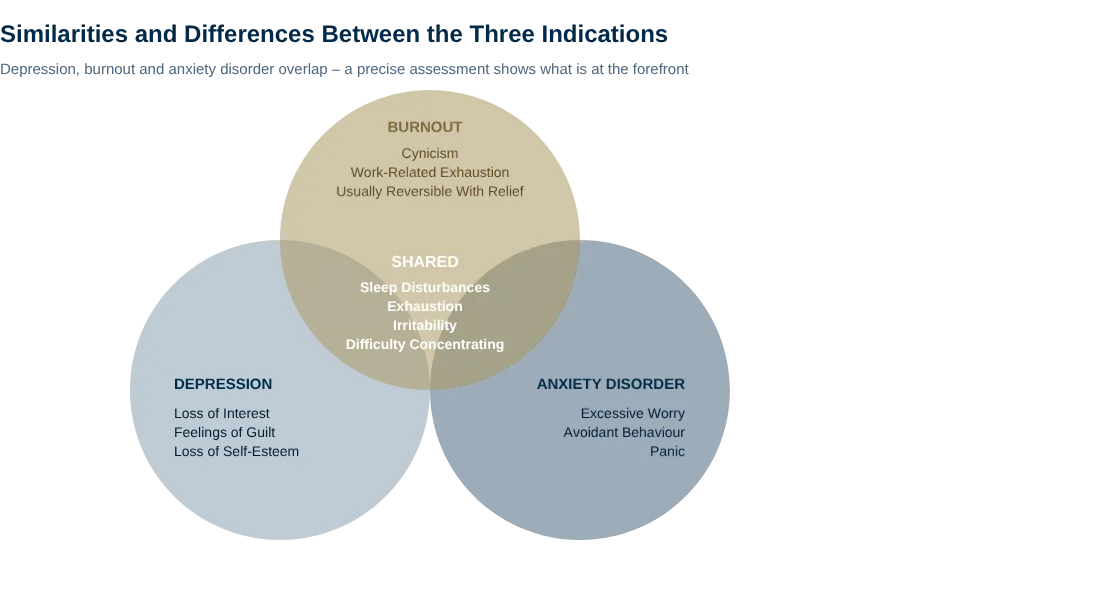
It is important to distinguish this condition from other forms of stress, as this guides treatment. Burnout describes a state of work-related exhaustion, but is not a diagnosis in its own right; there is often an overlap with depressive disorders. Burnout manifests itself primarily as work-related exhaustion, cynicism and reduced performance, whereas depression usually affects several areas of life – including enjoyment, sleep, motivation and self-esteem.
Also anxiety disorders, somatoform disorders or problematic substance use may also occur in parallel. Anxiety disorders manifest themselves primarily as excessive worry, panic or avoidance. Overlaps are common; a precise diagnosis clarifies which condition is predominant and which treatment is appropriate.
3.3 Double Depression and the Urgent Need for Action
If left untreated, there is a risk of the condition becoming chronic. Periods of apparent stability may alternate with relapses. Of particular relevance is what is known as ‘double depression’: against a background of persistent, mild depressive symptoms (dysthymia), the person’s state of mind ‘tips over’ into a fully-fledged episode – often accompanied by increased despair and a feeling of losing control. Anyone who notices such a development in themselves should seek medical or psychotherapeutic support without delay.
An urgent assessment is required if you experience severe loss of motivation, pronounced sleep disturbances, a marked decline in performance, physical symptoms with no identifiable cause, or suicidal thoughts. In acute crises, please contact the medical emergency service (116 117), the ambulance service (112) or the nearest psychiatric clinic.
What Helps in Everyday Life – and What Are the Limits of Self-help?
Self-care can provide relief, but it is no substitute for treatment when symptoms are severe. In the case of high-functioning depression, it is helpful not to invest ‘even more effort’ in self-help, but rather to focus specifically on promoting rest, social support and realistic expectations. If symptoms persist for weeks or worsen, it is advisable to seek medical advice – a clear diagnosis provides guidance and enables effective, individually tailored treatment.
4.1 First Steps in Self-care
Tried-and-tested, practical measures can help to stabilise your situation. These are not compulsory programmes, but rather kind gestures towards yourself:
- Prioritise sleep hygiene: a regular routine, digital breaks in the evening, a quiet sleeping environment
- Structure your day with small, manageable steps rather than simply fulfilling obligations
- Moderate and regular exercise, without overexertion
- Consciously nurture social contact, even when the urge to withdraw is strong
- Practise self-compassion: soften your inner tone, reflect on standards of perfection
Observe what does you good – and what tends to cause stress. The aim is relief, not additional strain.
4.2 Speaking Openly and Recognising Boundaries
A conversation with trusted individuals, your GP or a psychotherapy practice can be an important turning point. Many people affected report that simply putting a name to the ‘invisible’ burden brings relief. In a work context, tailored solutions such as a gradual reduction in workload or periods of working from home can be helpful, without overburdening yourself.
The earlier depression requiring treatment is recognised, the better the chances of stabilisation and relapse prevention – this also applies even if the symptoms initially appear ‘high-functioning’. Well-founded treatment addresses both the symptoms and the underlying patterns, such as excessive self-expectations.
Treatment at the Limes Schlossklinik Bergisches Land
The LIMES Schlossklinik Bergisches Land offers an integrative, individually tailored treatment programme for depressive disorders – including cases experienced as high-functioning depression. The process begins with a comprehensive psychiatric, psychological and psychosomatic assessment, which takes mental and physical factors into account and distinguishes between depressive disorders, burnout, anxiety disorders and somatic causes. Building on this, a personalised treatment plan is drawn up to alleviate symptoms, identify the underlying causes and develop sustainable strategies for daily life and work.
The treatment is supported by the clinic’s unique setting: the Healing Environment at Heiligenhoven Castle, nestled within extensive parkland, creates a setting in which retreat and recuperation become possible in the first place.
Depending on the situation, specific therapeutic components may include, amongst other things:
- Comprehensive assessment and psychoeducation
Psychiatric, psychological and psychosomatic assessment, including laboratory tests and, where necessary, internal medicine examinations, supplemented by a clear explanation of one’s own symptoms.
- High-frequency psychotherapy in individual and group settings
Close therapeutic support that facilitates rapid progress whilst offering a space for exchange within the safe environment of the group.
- Cognitive behavioural therapy and disorder-specific approaches
Work on rumination, sleep and building up activity levels, supplemented by mindfulness-based, metacognitive and emotion-focused methods, as well as schema therapy for rigid perfectionist patterns.
- Relaxation therapy with mindfulness and breathing exercises
Progressive muscle relaxation according to Jacobson, yoga and qigong to enhance stress regulation.
- Dance, movement, art, occupational and physiotherapy
Body-based and creative therapeutic approaches that promote body awareness and self-efficacy.
- LIMES Sports.Care
A scientifically based, individually tailored training programme developed in collaboration with stress expert and sports medicine specialist Prof. Dr Uwe Nixdorff.
- Pharmacotherapy and somatic adjunctive treatment
Considered where indicated following a thorough assessment and closely supervised by a doctor.
- Support for relatives and aftercare
Couples’ and family counselling, as well as a condition-specific plan for returning to everyday working life, with a gradual increase in workload.
The aim of the treatment goes far beyond simply reducing symptoms: it is about bringing about lasting change to the underlying patterns – excessive demands, a lack of self-care, a self-image tied to performance – so that stability endures even after treatment has ended.
Find out now about the admission process – discreet, straightforward and with no long waiting times.
FAQ
6.1 Is High-functioning Depression Less ‘serious’ Than Other Forms of the Condition?
Not necessarily. How well someone functions on the outside says little about the psychological distress they are experiencing on the inside. Even if they are able to carry out their daily tasks, symptoms may still be pronounced. There is also a risk of seeking help too late. What matters is the severity, duration and extent of the impairment – not whether ‘everything is still running smoothly’.
6.2 How Do I Raise the Subject With My Gp or at a Surgery?
Describe specifically what has been troubling you and for how long – your mood, sleep, motivation, sense of joy, rumination, physical symptoms – and how your daily life is being affected, even if you are still working. A few key points will suffice. Your GP will help to assess your depression and take the appropriate next steps, such as referrals, psychotherapy or, if necessary, medication.
6.3 Can I Carry on Working Whilst Undergoing Treatment – or Is a Break Necessary?
That depends on the severity, context and stage of treatment. Sometimes a temporary reduction in workload or a break is advisable to stabilise your condition and prevent relapses. In other cases, continuing to work in a coordinated manner with clear boundaries can be successful. Individual, professional planning is crucial here.
Please note: This article is not a substitute for a personal diagnosis or treatment. In the event of an acute crisis, please contact emergency services or seek medical help immediately.
Kategorien: Depression