Long Covid And Mental Exhaustion – Taking The Mental Health Consequences Seriously
Long COVID and Mental Exhaustion: When Your Strength Doesn’t Return
1.1 What Does Exhaustion Mean in This Context?
1.2 Distinction: Tiredness, Fatigue, Depression, Burnout
Overview of Symptoms and Warning Signs
2.1 Common Symptoms Related to Fatigue
2.2 Cognitive and Emotional Consequences
2.3 When Should I Seek Medical or Psychotherapeutic Help?
What Lies Behind It? Possible Causes and Mechanisms
3.1 Physical Mechanisms
3.2 Psychological Stressors
3.3 Interactions and Risk Factors
Diagnosis, Daily Life and Energy Management
4.1 Medical Assessment: What Does It Involve?
4.2 Self-monitoring, Pacing and Daily Life
Treatment Options at the LIMES Schlossklinik Bergisches Land
6.1 Is Long COVID Fatigue the Same as Depression?
6.2 Can I ‘Train Away’ the Fatigue Through Exercise?
6.3 How Do I Find the Right Place to Go for Treatment?
Long Covid and Mental Exhaustion: When Your Strength Doesn’t Return
Many people affected report Long COVID fatigue that persists for weeks or months after the acute infection and can severely disrupt daily life. This form of fatigue cannot simply be remedied by sleep or a weekend off. It affects the body, the mind and emotions – and it is unsettling. It is important to recognise that these symptoms are real, they are common, and they deserve careful medical and psychological assessment.
Psychological exhaustion, in particular, is easily misunderstood. A lack of motivation, concentration problems or irritability are not necessarily caused by ‘mere stress’. People with high levels of professional responsibility, in particular, tend to carry on functioning and only recognise their limits at a late stage. However, persistent exhaustion is not a sign of a lack of discipline, but a signal that warrants a structured assessment – both physical and psychological.
What Does Exhaustion Mean in This Context?
‘Fatigue’ describes a pronounced, persistent sense of exhaustion that is disproportionate to the preceding activity and does not respond adequately to rest. In the case of fatigue syndrome associated with Long COVID, mental fatigue, concentration difficulties (‘brain fog’), sleep problems and increased sensitivity to stimuli may also occur.
Some affected individuals report a worsening of their condition following exertion (post-exertional malaise, PEM), i.e. a delayed ‘crash’ following physical or mental activity, which often only sets in hours later and is therefore difficult to attribute to the cause. Depending on its severity, exhaustion can exacerbate psychological symptoms or, conversely, be perpetuated by psychological stress – for example, due to concerns about one’s own health, conflicts at work or social isolation.
Distinction: Tiredness, Fatigue, Depression, Burnout
In practice, there is some overlap; the distinction can be made through medical history, examination and the course of the symptoms. A clear distinction is both possible and useful, as it points the way to the appropriate next steps:
- Fatigue
A normal bodily response that reliably improves after rest.
- Fatigue
Lasts longer, is disproportionate to the level of exertion and often also affects cognitive performance.
- Depression
A persistently low mood, loss of interest and negative thoughts; may accompany fatigue, but is not the same thing. - Burnout
Work-related exhaustion characterised by emotional detachment and a decline in performance.
Overview of Symptoms and Warning Signs
Long COVID symptoms are varied and range from breathing difficulties to neurological and mental health issues. This article focuses on the mental aspect and the fatigue that can affect many areas of life. Many people affected describe how even familiar everyday tasks – work, housework, meeting friends – take a disproportionate amount of energy.
Common Symptoms Related to Fatigue
A combination of physical and cognitive fatigue is characteristic. This is often accompanied by mood swings, anxiety about being overwhelmed again, and uncertainty about managing one’s own energy levels. Typical warning signs include:
- lack of restorative sleep
- Problems with memory and concentration
- A lower sensitivity to noise and light
- Emotional overwhelm and reduced stress tolerance
- Palpitations, dizziness when changing position, or muscle pain
- Post-exertional malaise (PEM)
The spectrum also includes shortness of breath, chest tightness, changes in smell and taste, headaches and autonomic dysregulation. These symptoms can exacerbate fatigue and should be medically assessed before treatment goals are agreed. Not all symptoms need to occur simultaneously; their severity varies from person to person. PEM is particularly significant: activity should then be approached cautiously, in a symptom-oriented manner and tailored to the individual.
Cognitive and Emotional Consequences
‘Brain fog’ describes a slowing of thought processes, difficulty finding the right words and impaired memory. Those affected report that they find it harder to follow conversations, process information more slowly or avoid complex tasks. Emotionally, this can lead to frustration, withdrawal or anxiety – particularly when performance at work or within the family suffers.
Those who are used to handling complex situations with confidence often find this condition particularly frustrating. For the treatment of Long COVID fatigue, this means that psychotherapeutic support should not overlook the physical aspects, but should take the interplay between them into account – with targeted psychoeducation, realistic goals and strategies for reducing stimuli and stress.
When Should I Seek Medical or Psychotherapeutic Help?
Take persistent or worsening symptoms seriously – especially if your ability to work, family life or basic needs are affected. An interdisciplinary assessment helps to identify the causes and plan a realistic course of action.
- If fatigue and cognitive impairments persist for more than four to twelve weeks after the acute infection and significantly restrict your daily life.
- If symptoms repeatedly worsen after exertion and you are unsure how to pace your activities.
- If you also experience symptoms of depression, anxiety, panic attacks or social withdrawal.
- If you experience circulatory problems, severe dizziness, chest pain or new neurological symptoms – please seek medical advice.
What Lies Behind It? Possible Causes and Mechanisms
The causes of exhaustion following COVID-19 are the subject of intensive research. There is strong evidence to suggest a multifactorial process. It is important to consider the overall situation: biology, mental health and everyday life are all intertwined. Anyone who has been living at the limits of their capacity for months, who is worried about the future or who receives little social support may develop additional exhaustion – even if the physical long-COVID symptoms subside.
Physical Mechanisms
For some of those affected, the clinical picture corresponds to a fatigue syndrome associated with Long COVID, in which physical and neurocognitive symptoms occur together and rest has only a limited effect. Symptoms described include:
- Inflammatory processes and persistent immune activation
- Dysregulation of autonomic functions (e.g. POTS-like symptoms)
- Disorders of mitochondrial function
- Microvascular changes
- Disturbances of the sleep-wake cycle
It is essential to distinguish this from other causes such as anaemia, thyroid disorders or sleep apnoea. This physical basis does not mean that psychotherapeutic approaches are unnecessary – on the contrary: they can help people cope with the consequences, adapt to stressors and reduce symptoms. It is crucial to respect the physical situation and avoid overburdening the individual.
Psychological Stressors
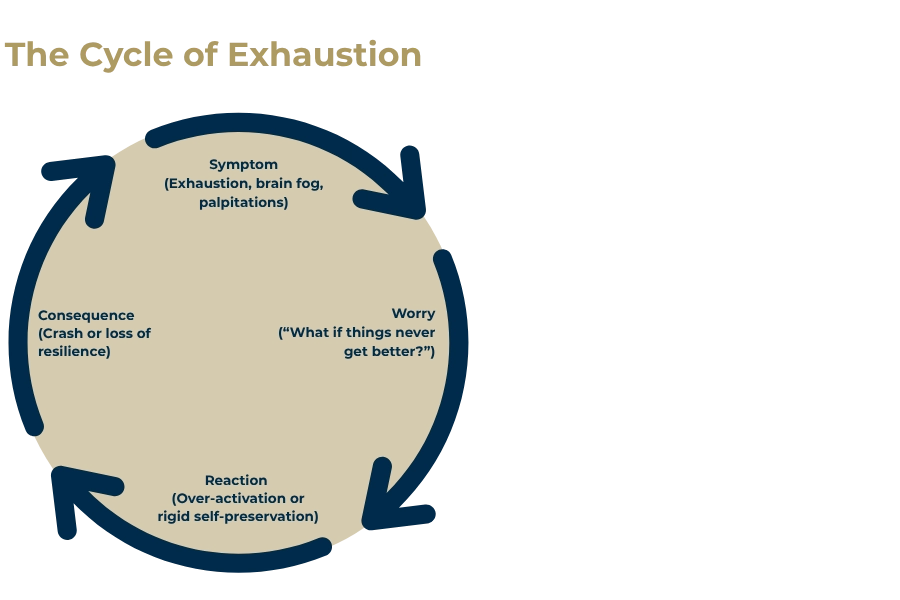
Long-lasting symptoms can trigger feelings of insecurity, helplessness and anxiety about the future. The loss of familiar routines, professional roles or social activities places an additional strain on the individual. Sleep problems, rumination and self-protective behaviour can fuel a vicious circle of psychological exhaustion.
Psychotherapy helps here by strengthening self-compassion, setting realistic daily goals and gaining confidence in managing one’s limits. Perfectionism and high expectations of oneself often complicate this process: over-exertion driven by fear of a decline in performance should be avoided just as much as rigid avoidance. The right balance is individual – and it can change over time.
Interactions and Risk Factors
Interactions arise when physical symptoms increase stress and stress, in turn, intensifies the perception of symptoms. Known risk factors for persistent long COVID symptoms include, amongst others:
- Severe courses of the disease and multiple infections
These factors increase the likelihood that symptoms will persist for months.
- Pre-existing conditions
Both mental and physical pre-existing conditions can hinder recovery. - High levels of chronic daily stress
Those who are already living at their limits have fewer reserves for recovery.
In practice, this means that an integrative approach, which takes both physical and psychological aspects into account, increases the chances of regaining stability. This applies particularly to the treatment of Long COVID fatigue, planning energy management, and returning to everyday life and work.
Diagnosis, Daily Life and Energy Management
The first step is always a medical assessment: what exactly are the symptoms? Since when? What makes them better or worse? The aim is to identify treatable causes, rule out dangerous complications and realistically assess the individual’s resilience. At the same time, a psychosomatic assessment can clarify the extent to which mood, motivation, sleep and everyday circumstances contribute to the symptoms. In cases of persistent Long COVID fatigue, a joint assessment by internal medicine, neurology and psychosomatic medicine is often beneficial. The earlier this interplay is recognised, the more effectively countermeasures can be taken.
Medical Assessment: What Does It Involve?
A structured diagnostic approach combines the patient’s medical history, a physical examination and selected tests. The aim is not to ‘test for everything’, but to take a targeted approach and minimise the burden on those affected.
- Targeted basic diagnostic tests
Complete blood count, inflammation markers, thyroid function, iron status, and, where relevant, vitamin levels – depending on symptoms and pre-existing conditions.
- Cardiopulmonary assessment
ECG, echocardiography and lung function tests where appropriate – if shortness of breath, chest tightness or palpitations are present.
- Neurological and cognitive assessment
Examination and simple neuropsychological screenings for ‘brain fog’.
- Sleep-related diagnostics
Assessment of insomnia; where appropriate, diagnostic investigations for sleep-related breathing disorders.
- Psychosomatic assessment
Assessment of stressors, coping strategies, mood and anxiety symptoms.
Self-monitoring, Pacing and Daily Life
A symptom and activity diary can help to identify patterns: What reliably leads to exhaustion? When does PEM occur? Which rest periods help? This knowledge is central to pacing – that is, the conscious management of energy levels below one’s individual threshold. Setbacks are a source of information, not a failure. Three principles apply in everyday life:
- Taking stimulus reduction seriously
Short breaks away from screens and noise, in a quiet environment.
- Quality over quantity
It is better to structure and complete one task than to start many and leave them half-finished. - Pick up on the warning signs early
The first signs of being overwhelmed are a stop signal – not a reason to ‘just finish it quickly’.
In cases of severe PEM, increasing activity should be done very cautiously, in small steps and with sufficient rest periods. A return to work or education is often achieved through a phased reintegration, flexible working hours and clear prioritisation. In everyday family life, transparent agreements and support from those around you are helpful. Be kind to yourself: learning new limits takes time and is not a sign of weakness. If you find that self-help is not enough or that you are going round in circles, you should see this as a sensible time to seek professional support.
Treatment Options at the Limes Schlossklinik Bergisches Land
At the LIMES Schlossklinik Bergisches Land , we address Long COVID fatigue with an integrative, personalised treatment approach. Treatment begins with a comprehensive psychiatric, psychological and psychosomatic assessment, including a medical evaluation. Based on this, a treatment plan is drawn up that takes into account your symptoms, your resilience and your personal goals.
The treatment of Long COVID fatigue is carried out in close consultation with those affected: realistic milestones, symptom-oriented pacing and a careful management of activity levels are key principles. Where necessary, we liaise with specialists in somatic disciplines. Suitable therapeutic components may include, depending on the situation:
- Diagnosis and psychoeducation
Psychoeducation explains in an accessible way what fatigue means, how PEM is recognised and how energy can be managed effectively. This shared understanding makes all subsequent steps easier.
- High-frequency psychotherapy
In both individual and group settings, elements drawn from cognitive-behavioural, mindfulness-based and schema therapy approaches help to establish helpful routines and treat symptoms of depression or anxiety.
- Relaxation therapy
Mindfulness and breathing exercises, as well as progressive muscle relaxation according to Jacobson, help you to become more aware of tension and to regulate it gradually.
- LIMES Sports.Care
Our scientifically based, individually tailored training programme is planned to suit your specific needs and takes particular account of the risk of a deterioration in your condition following overexertion.
- Medical Co-treatment and Pharmacotherapy
Depending on the findings, medication may be advisable, for example in cases of sleep disorders, depressive symptoms or pain syndromes. Where necessary, we involve specialists in cardiology, neurology or sleep medicine. - Healing Environment in peaceful surroundings
The secluded setting of Heiligenhoven Castle within extensive parkland forms part of the therapeutic approach and provides the space needed for genuine recuperation.
The aim of treatment is not merely to reduce individual symptoms. What is crucial is that you regain confidence in your own resilience and are better able to cope with exhaustion, tension and personal stressors in the long term. In this way, the treatment of Long COVID fatigue continues to be supported in a structured manner even after your stay at the clinic.
FAQ
Is Long Covid Fatigue the Same as Depression?
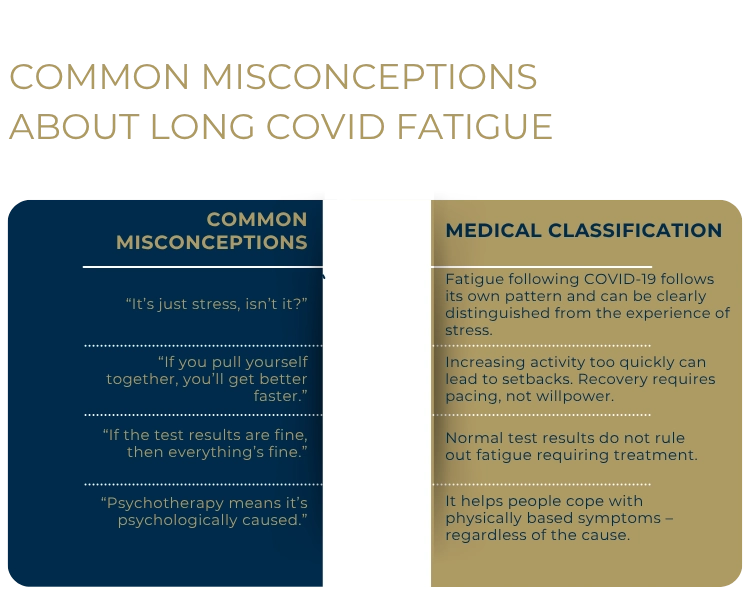
No. There are overlaps, such as a lack of motivation and sleep disturbances, but the causes and courses of the conditions differ. With Long COVID, the focus is often on physical and cognitive fatigue that is not proportional to the level of exertion and improves only to a limited extent with rest. A depression may also occur and should then be treated specifically. A detailed diagnosis helps to distinguish between the two.
Can I ‘train Away’ the Fatigue Through Exercise?
Many people benefit from gentle physical activity – though this should be tailored to the individual and focused on managing symptoms. Particular caution is required with PEM: increasing the intensity too quickly can trigger setbacks. Structured pacing, small steps and sufficient rest periods are therefore essential. It is best to seek medical and therapeutic support before implementing any exercise plans.
How Do I Find the Right Place to Go for Treatment?
Start by consulting your GP and openly discussing your main symptoms. Depending on the findings, referrals to specialists – such as cardiologists, neurologists or sleep medicine specialists – may be advisable. In cases of severe psychological exhaustion, persistent fatigue or significant impairment of daily life, psychosomatic or psychiatric treatment – either as an outpatient or inpatient – may help. The LIMES Schlossklinik Bergisches Land can advise you on the most appropriate next steps.