Trauma-Related Disorders in Adulthood – The Long-Term Effects of Early Experiences
Context: What Trauma-Related Disorders Mean in Adulthood
1.1 What Counts as a Traumatic Experience?
1.2 Types of Post-traumatic Stress Disorders
How Early Experiences Have a Lasting Impact: Mechanisms From the Body to Behaviour
2.1 The Stress System and Memory
2.2 Attachment, Self-Image and Relationships
2.3 Physical Symptoms and Psychosomatic Disorders
How to Recognise the Late Effects of Trauma: Symptoms, Patterns, Distinctions
3.1 Common Key Symptoms in Adulthood
3.2 Distinction: Stress Reaction or a Disorder Requiring Treatment?
3.3 Risk Factors and Protective Factors
Diagnosis and First Steps Towards Help
4.1 When Is the Right Time to Seek Help?
4.2 What Kind of Assessment Is Appropriate?
4.3 What Relatives Can Do
Treatment at the LIMES Schlossklinik Bergisches Land
5.1 Key Therapeutic Components
5.2 Stabilisation, Additional Therapeutic Approaches and Aftercare
Coping With Everyday Life and Long-Term Perspectives
6.1 Self-Care Without Overburdening
6.2 Dealing With Triggers in Everyday Life
6.3 Work, Relationships and Quality of Life
7.1 Can Early-Life Trauma Still Be Effectively Addressed Decades Later?
7.2 What Role Do Medications Play in Trauma-Related Disorders?
7.3 How Do I Know Which Form of Therapy Is Right for Me?
Context: What Trauma-Related Disorders Mean in Adulthood
Many people experience situations in childhood or adolescence that profoundly undermine their sense of security – such as violence, neglect, accidents or severe loss. Not every traumatic experience leads to an illness. However, if psychological, physical or social impairments develop over a prolonged period, this is referred to as the consequences of trauma. This refers to persistent reactions to extremely stressful events that restrict one’s current life and, depending on their severity, may require professional support.
Particularly in adulthood, the long-term effects of past experiences often manifest indirectly: through persistent tension, sleep disturbances, recurring fragments of memory, difficulties in relationships, or physical symptoms with no clear organic cause. Traumatised adults often describe the feeling of being overwhelmed ‘out of the blue’, even though the triggering situation occurred a long time ago. This article offers a clear overview – but is no substitute for a personal diagnosis.
What Counts as a Traumatic Experience?
An experience is described as traumatic when an event is exceptionally threatening or catastrophic and can trigger deep despair, fear or helplessness in almost anyone. This includes, for example, physical or sexual violence, prolonged emotional neglect, serious accidents, natural disasters or experiences of war. What matters is not just the event itself, but also whether protection and support were available and how the nervous system processed the experience.
Types of Post-traumatic Stress Disorders
Traumatic stress can lead to a variety of clinical presentations. These are carefully distinguished from one another in diagnosis, as the focus of treatment may vary.
- Acute stress reaction
Temporary, often intense reactions in the first few days to weeks following an event; in many cases, these subside.
- Post-traumatic stress disorder (PTSD)
Persistent symptoms such as intrusive memories, avoidance, hyperarousal and altered negative thinking and feelings.
- Complex PTSD
In addition to PTSD symptoms, difficulties with emotional regulation, a negative self-image and interpersonal problems frequently occur, often following prolonged or repeated experiences in childhood.
- Dissociative symptoms or disorders
such as feeling detached from oneself, memory lapses or a sense of alienation from one’s own body, which may be linked to past traumatic experiences.
How Early Experiences Have a Lasting Impact: Mechanisms From the Body to Behaviour
Early experiences shape how we assess danger, calm ourselves and form relationships. This explains why the effects of trauma sometimes only become apparent years later in new life stages, such as when starting a family, undergoing career changes or interacting with one’s own children. If past stressors touched upon needs for protection at the time, similar patterns can be triggered involuntarily today.
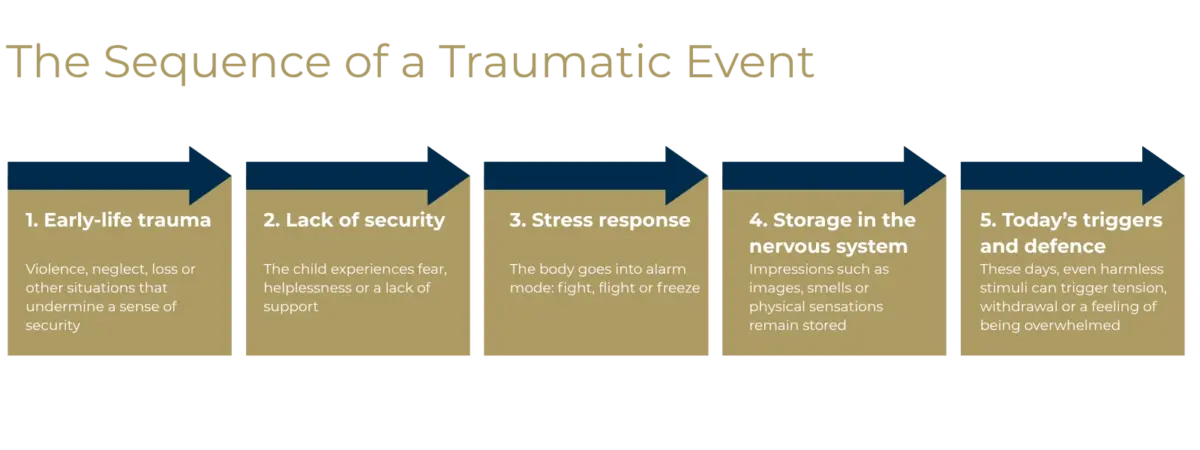
Anyone wishing to process childhood trauma as an adult benefits from understanding the biological and psychological mechanisms involved. The nervous system learns from experience: it evaluates stimuli, stores them in context-dependent ways and responds with protective responses such as fight, flight or freeze. These automatic patterns are initially useful, but can become burdensome in everyday life if they occur too frequently or in inappropriate situations.
The Stress System and Memory
During extreme stress, neurotransmitters and hormones are released to ensure survival. In the process, memories may be stored in a fragmented manner: images, smells or bodily sensations may surface suddenly, whilst coherent narratives are missing. At the same time, the nervous system ‘remembers’ which signals might indicate danger. This is how triggers arise – harmless stimuli that set off an alarm because they remind us of past situations.
- Constant tension
The stress response system remains ‘activated’ more frequently, and sleep and rest become disrupted.
- Fragments of memory
Individual impressions intrude without being able to be firmly situated in time and space.
- Excessive caution
Situations are classified as threatening when in doubt, leading to withdrawal or avoidance.
Attachment, Self-Image and Relationships
If caregivers were themselves a source of fear in the past or were unable to provide security, this influences attachment experiences. In adulthood, closeness and trust can then trigger conflicting feelings. Some react with intense dependence, others with distance, whilst others fluctuate between the two. Self-image is often tinged with negativity (“It’s my fault”, “There’s something wrong with me”), which makes coping even more difficult.
Physical Symptoms and Psychosomatic Disorders
The body also sends signals: Headaches, gastrointestinal complaints, dizziness, diffuse pain or exhaustion may be linked to unprocessed stress – particularly if organic causes do not explain everything. Such physical signals are real and deserve serious medical investigation. At the same time, it may be helpful to carefully explore possible links with early experiences.
How to Recognise the Late Effects of Trauma: Symptoms, Patterns, Distinctions
Not every memory of a difficult time indicates an illness. The key factors are frequency, intensity and the impact on daily life. Many traumatised adults report ‘internal alarms’ that seem to go off suddenly, and difficulties in calming down. The desire to overcome trauma is understandable – but this often requires a structured, professionally supported process.
The effects of trauma manifest in adults in various areas: in experience (e.g. intrusive images), in behaviour (e.g. avoidance), in the body (e.g. palpitations, startle response) and in relationships (e.g. mistrust, withdrawal). Depending on life circumstances, phases with more or fewer symptoms may occur.
Common Key Symptoms in Adulthood
The following symptoms vary in severity and must be assessed individually. Combinations of several areas are typical.
- Involuntary memories and nightmares
Images come to mind that are difficult to stop. - Avoidance and numbing
Places, conversations or feelings are avoided; sometimes substances come into play. - Persistent overexcitement
Inner restlessness, irritability, difficulty concentrating and sleeping, and severe startle responses. - Negative view of self and the world
Feelings of guilt and shame, mistrust, a sense of alienation. - Dissociation
Dazedness, feeling ‘out of it’, memory lapses.
Distinction: Stress Reaction or a Disorder Requiring Treatment?
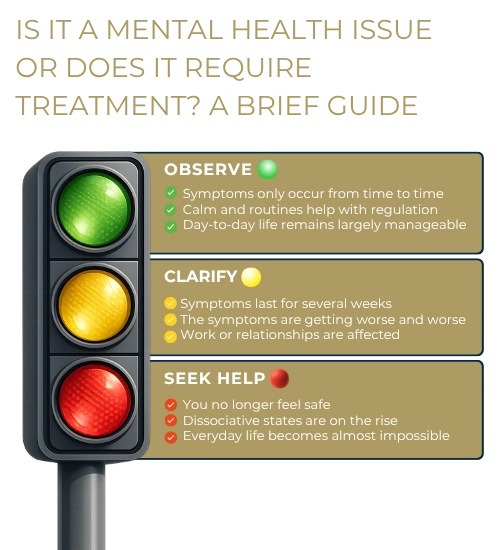
Temporary reactions are normal following traumatic events. A professional assessment is advisable if symptoms persist for several weeks, become more severe or significantly restrict social and professional life. Another indication is an increase in coping strategies such as avoidance or substance use. The aim of the diagnosis is to determine appropriate treatment steps – not to judge experiences.
Risk Factors and Protective Factors
Whether and how the consequences of trauma arise depends on many factors. Risk and protective factors provide guidance, but never replace an individual assessment.
- Risk factors: Prolonged or repeated stress, lack of support, early attachment insecurity, additional current stressors, genetic and neurobiological vulnerabilities.
- Protective factors: reliable attachment figures, social networks, learned emotional regulation, stable daily routine, access to professional help.
Diagnosis and First Steps Towards Help
Anyone wishing to come to terms with childhood trauma as an adult often benefits from a thorough, respectful assessment. In addition to current symptoms, this takes into account their life history, physical health and personal resources. The aim is to provide a clear understanding of the situation and a personalised treatment plan – not to ‘reopen old wounds’ at any cost.
The effects of trauma often occur alongside other issues, such as depression, anxiety disorders, sleep disorders or addiction. These overlaps are taken into account in the diagnostic process because they can influence the treatment steps. A trusting therapeutic relationship is central to this.
When Is the Right Time to Seek Help?
At the very latest when symptoms have persisted for several weeks, significantly restrict your daily life, or you do not feel sufficiently secure in moments of crisis, it makes sense to seek professional support. Repeated relationship conflicts, absences from work or increasing withdrawal are also important warning signs.
What Kind of Assessment Is Appropriate?
A specialist medical or psychological assessment looks at the overall picture. In addition to a detailed consultation, standardised questionnaires and – if necessary – physical examinations are used. Risk assessment, crisis planning and jointly setting achievable therapeutic goals are also important.
- Psychiatric, psychological and psychosomatic assessment to classify symptoms and establish differential diagnoses.
- Identification of resources and stressors to plan sustainable steps.
- Education (psychoeducation) on typical mechanisms and pathways to stabilisation.
What Relatives Can Do
Relatives often play an important role. Understanding and clear boundaries are equally important. The following tips have proven helpful:
- Listening without pressing
Those affected decide for themselves when and how much they wish to share. - Structuring daily life
Support with appointments, household chores or childcare can provide relief. - Making crisis arrangements
Agree on emergency contacts and steps to take in stressful situations together. - Respecting your own boundaries
Self-care protects family members from becoming overwhelmed.
Contact the LIMES Schlossklinik Bergisches Land now if you would like to seek professional help.
Treatment at the Limes Schlossklinik Bergisches Land
In cases of severe trauma, inpatient or day clinic treatment may be advisable – particularly if outpatient support is insufficient, crises are increasing, or multiple conditions are present. At the LIMES Schlossklinik Bergisches Land , medical, psychological and therapeutic specialist departments work closely together to provide individualised support for traumatised adults.
The focus is on a safe, structured treatment environment. There, stabilisation, targeted trauma therapy and the development of practical everyday skills can go hand in hand. The goal is realistic: to alleviate symptoms, strengthen self-efficacy and – step by step – help overcome trauma without overwhelming the patient.
Key Therapeutic Components
Treatment is planned individually and regularly adapted. The following therapeutic components may be considered, depending on the indication:
- High-frequency psychotherapy in individual and group settings with a trauma-specific focus.
- Psychoeducation on symptoms, triggers and coping skills.
- Condition-specific psychotherapy, such as cognitive-behavioural therapy approaches, schema therapy or elements of DBT for PTSD.
- Pharmacotherapy following a thorough assessment to treat accompanying symptoms such as sleep disorders, anxiety or depression.
Stabilisation, Additional Therapeutic Approaches and Aftercare
In the early phase, the focus is often on stabilisation: emotion regulation, resource-building, crisis plans and safe management of dissociation. This may be followed – where indicated – by a careful confrontation with distressing memories. Approaches such as EMDR, imagery rescripting or exposure can be applied depending on individual history and capacity. A transparent process at the patient’s own pace is central.
Because trauma-related burdens often manifest physically as well, the programme includes relaxation therapy, mindfulness and breathing training, yoga, qi gong and progressive muscle relaxation (Jacobson method). Art therapy, occupational therapy, physiotherapy and the sports-medicine-guided movement therapy LIMES Sports.Care complement the offering to promote body awareness, strength and recovery.
Family or couples sessions can be arranged on request to improve communication and strengthen safe support structures. Early aftercare planning – including outpatient therapy appointments, self-help resources and crisis plans – helps consolidate progress and prevent relapse.
If you would like to find out whether treatment at LIMES is right for you, please visit us for information on our programme, admission process and contact details.
Coping With Everyday Life and Long-Term Perspectives
Processing childhood trauma as an adult often means learning new ways of self-care and establishing helpful routines. Small, realistic steps are more effective than grand resolutions. It is not about performance, but about inner security and reliability in everyday life.
Many people affected experience periods of rapid improvement followed by setbacks. This is not a sign of failure, but an expression of a learning process. With appropriate support, patience and practice, symptoms can usually be significantly alleviated and quality of life regained – overcoming trauma is a process that unfolds in stages.
Self-Care Without Overburdening
Self-care should strengthen, not add to stress. A simple, reliable foundation helps the nervous system to find peace.
- Sleep, diet, exercise
Regular routines and small, achievable goals are often more effective than striving for perfection. - Daily routine
Fixed routines such as meals, short walks or an evening ritual provide stability. - Safe places and people
Conscious time spent with people and in places that convey a sense of security.
Dealing With Triggers in Everyday Life
Triggers cannot be completely avoided. A personal toolkit for stressful situations is helpful. This includes breathing and grounding exercises, focusing awareness on the here and now (e.g. naming what you see, hear and feel), emergency cards with helpful phrases, and agreeing on brief ‘exit strategies’ in group or work situations. With practice, the nervous system becomes more adaptable – this makes it easier to overcome trauma.
Work, Relationships and Quality of Life
Stress often affects work and relationships. Open conversations – to the extent you feel comfortable – and clear agreements on breaks, boundaries and support are helpful. If needed, medical advice, phased reintegration or specific counselling services can be utilised.
Find out now about the treatment options at the LIMES Schlossklinik Bergisches Land.
FAQ
Can Early-Life Trauma Still Be Effectively Addressed Decades Later?
Yes, many people benefit from trauma-specific treatment even after a long time. The brain remains malleable. Careful diagnosis, a suitable therapeutic approach and a pace that ensures stability are crucial. The aim is to alleviate symptoms, build self-regulation and take a more active role in shaping one’s own life again. Complete freedom from symptoms is not always achievable, but significant improvements are possible in many cases.
What Role Do Medications Play in Trauma-Related Disorders?
Medication can be useful as a complementary treatment, for example for sleep disorders, anxiety or depression. However, it is no substitute for psychotherapy and is used following an individual risk-benefit assessment. As a rule, psychotherapy takes centre stage, whilst medication can support stabilisation and coping with daily life.
How Do I Know Which Form of Therapy Is Right for Me?
A trauma-sensitive approach, transparency and a trusting therapeutic relationship are important. The initial phase often focuses on stabilisation; trauma-specific methods such as EMDR, exposure therapy or imagery rescripting may follow once sufficient stability has been achieved. Ask for the approach to be explained to you, agree on interim goals and check whether you feel understood and respected.
Kategorien: Trauma