Media Addiction Among Young Adults – When Digital Use Becomes a Burden
Classification: Between Normal Use and Addiction
1.1 What Does ‘Problematic Use’ of Digital Media Mean?
1.2 Diagnostic Classification: What Is Established, What Is Changing?
Why Media Addiction Can Also Affect Adults
2.1 Developmental Tasks Between Autonomy and Attachment
2.2 Algorithms, Rewards and Habits
2.3 Transitions and Stress Peaks
Warning Signs, Symptoms and Severity
3.1 Early Warning Signs in Everyday Life
3.2 Typical Symptoms and Severity Levels
3.3 Comorbidities and Differential Diagnoses
Consequences for Health, Relationships and Performance
4.1 School, University, Work: When Attention Is Fragmented
4.2 Body and Sleep Rhythm
4.3 Relationships, Money and Security
Treatment at the LIMES Schlossklinik Bergisches Land
5.1 Diagnosis: Clarity Provides Direction
5.2 Psychotherapeutic Focus Areas
5.3 Everyday Training, Physical Activity and Involvement of the Wider Community
First Steps in Everyday Life: Assess, Relieve Pressure, Seek Support
6.1 Self-assessment: Three Key Questions
6.2 Everyday Tips That Often Help
6.3 When You Should Seek Professional Help
7.1 Is Media Addiction the Same as Gaming Disorder?
7.2 How Do I Distinguish Between High Usage and Pathological Usage?
7.3 Does Media Addiction Only Affect Young People?
Classification: Between Normal Use and Addiction
Digital media are, of course, part of everyday life for most adults. They inform, connect, entertain and make many things easier. At the same time, some affected individuals report that ‘always being online’ no longer feels good: concentration suffers, sleep patterns become disrupted, and responsibilities are neglected. In such cases, media addiction – that is, an addiction-like attachment to digital applications – may be behind this experience.
A high duration of use alone does not automatically indicate a disorder. Only when use becomes virtually uncontrollable over extended periods, key areas of life are impaired and it becomes increasingly difficult to stop, do experts speak of a pattern requiring treatment. Media addiction in adults often manifests in specific areas such as social media, gaming, streaming or constant smartphone use.
What Does ‘problematic Use’ of Digital Media Mean?
Problematic use occurs when digital applications take such centre stage that other needs and tasks are consistently pushed into the background. A typical sign is a growing addiction to digital media: those affected spend more time online than they intended, think about when they can next use these devices even when offline, and feel restless when their use is interrupted. Depending on its severity, this dynamic can develop into media addiction.
Diagnostic Classification: What Is Established, What Is Changing?
Gaming Disorder is established as a diagnosis in the international ICD-11 classification. For excessive social media use, there is established knowledge regarding problematic use, but formal diagnosis remains a subject of scientific debate. In practice, professionals rely on three criteria:
- Loss of control over the start, duration and cessation of use
- Continued use despite noticeable disadvantages
- Prioritising digital activities over other interests and responsibilities
This allows media addiction to be reliably classified without pathologising normal everyday use.
Why Media Addiction Can Also Affect Adults
Adult life is marked by recurring changes: starting a career and professional transitions, moving house, new relationships, shifting social networks, and responsibilities at work and in the family. Digital media take on many functions across all these phases of life – maintaining contact, information, learning, distraction, identity formation. This makes them valuable, but also tempting, as they offer rewards available around the clock.
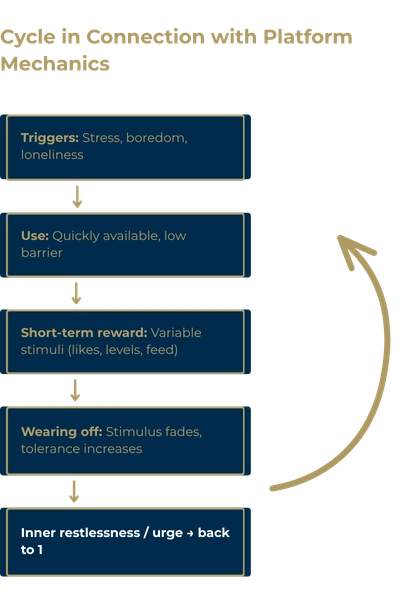
Added to this are platform mechanisms such as personalised feeds, variable rewards (likes, progress levels, loot boxes) and social comparison dynamics. These factors encourage – particularly in the face of stress, loneliness or a lack of coping strategies – the development of media addiction. At the same time, the line is blurred: what is a resource for one person may become a burden for another.
Developmental Tasks Between Autonomy and Attachment
Throughout adulthood, life roles, relationships and demands keep changing. Digital spaces facilitate a sense of belonging, but can also create pressure: constant availability, fear of missing out (FOMO), idealised self-presentation. Those who were already vulnerable at a younger age often continue this pattern: media addiction that begins early can – without conscious countermeasures – carry over into working and family life.
Algorithms, Rewards and Habits
Apps and games are designed to capture attention. Short-term rewards reinforce habits and weaken self-control. The following factors have a particularly strong effect:
- Variable rewards: Likes, levels or loot boxes arrive at irregular intervals
- Personalised feeds: Tailored content makes it difficult to stop
- Social comparisons: Reach and reactions create pressure to maintain a presence
In this way, usage becomes linked to one’s mood, until other strategies wither away.
Transitions and Stress Peaks
Peak stress periods are critical milestones: phases in which demands, uncertainty and change converge. When familiar structures are absent and stress levels rise, digital use quickly becomes the available outlet. Particularly common are:
- Exam and deadline periods
- Moving house, leaving home or starting university
- Relationship breakdowns and conflicts
- Starting a career and new routines
In such times, problematic use can become a way out and become entrenched. Keeping a close eye on routines, sleep and support helps to take timely countermeasures.
Warning Signs, Symptoms and Severity
Not all intensive media use is pathological. The key factor is whether the use impairs one’s ability to control one’s behaviour and quality of life. Media addiction often develops gradually: daily life becomes increasingly organised around screen time, breaks take a back seat, tolerance increases – it takes ever more time to achieve the same effect.
Many affected individuals experience phases of intense craving as well as withdrawal-like symptoms when use is interrupted (inner restlessness, irritability, the feeling of missing out). There are often accompanying factors, such as depressive symptoms, anxiety disorders, ADHD or social insecurity. These can contribute to media addiction and continue to have an impact well into adulthood.
Early Warning Signs in Everyday Life
Early signs can often be spotted in daily life. Context is key: one-off incidents are normal, but recurring patterns are more significant.
- Increasing loss of control
The intention to “just have a quick look” regularly fails, and time spent online stretches out considerably. - Neglect of responsibilities
Studies, training or work suffer; appointments are cancelled. - Disrupted sleep
Scrolling through social media, binge-watching series or gaming into the early hours of the morning. - Mood swings when interrupted
Irritability, nervousness, a feeling of inner emptiness without a smartphone (a sense of ‘mobile phone addiction’). - Social withdrawal
Face-to-face contact becomes less frequent; digital contact replaces in-person encounters.
Typical Symptoms and Severity Levels
In cases of severe media addiction, digital activities take centre stage for months on end: thoughts revolve around the next session, responsibilities are neglected, and performance declines. Some experience a clear addiction, whilst others use media as a coping mechanism to manage stress, loneliness or sadness. The severity ranges from:
- Risky use with initial friction
- Problematic use with recurring loss of control
- Manifest disorder with significant functional impairment
As the severity increases, so does the need for treatment – and the benefits of early intervention.
Comorbidities and Differential Diagnoses
It is not uncommon for comorbid conditions such as depression, anxiety disorders, ADHD, obsessive-compulsive spectrum disorders or substance use to be present. These can exacerbate or mask symptoms. Conversely, untreated media addiction in adults can exacerbate depressive moods, self-esteem issues or panic. A thorough diagnosis clarifies what is the cause, trigger or consequence.
Find out more here about the treatment areas at LIMES Schlossklinik Bergisches Land.
Consequences for Health, Relationships and Performance
When digital use becomes a burden, this manifests itself on several levels. Physically, it often involves sleep deprivation, headaches, neck and back pain, and inner restlessness. Psychologically, listlessness, low mood, nervousness or a feeling of being constantly overwhelmed may also arise. Socially, closeness suffers: conversations become more superficial, and conflicts over screen time increase.
School, University, Work: When Attention Is Fragmented
Micro-interruptions are often the trigger: notifications, quick checks, switching between tasks. This fragmentation strains working memory and increases the time required. Those who already suffer from exam anxiety or procrastination often use digital distractions to reduce pressure in the short term – with long-term consequences for goal achievement and self-esteem.
Body and Sleep Rhythm
Blue light, late-night gaming or binge-watching TV series disrupt the body’s internal clock. The consequences are difficulty falling asleep, non-restorative sleep and daytime tiredness. Reduced physical activity and an unhealthy diet can also play a part. A persistent addiction to digital media thus indirectly increases health risks.
Relationships, Money and Security
When digital use gets out of hand, several areas of life come under pressure – particularly these three:
- Relationships: Conflicts over presence and reliability
- Money: In-app purchases, loot boxes or paid subscriptions
- Safety: Data protection, cyber grooming, problematic communities
These issues should be addressed early on.
Treatment at the Limes Schlossklinik Bergisches Land
When personal strategies are no longer sufficient or significant limitations are already present, professional support is advisable. At the LIMES Schlossklinik Bergisches Land , problematic digital usage patterns are assessed in a nuanced manner and treated using evidence-based approaches – always taking into account personality, life circumstances and any co-occurring conditions.
The aim is not digital abstinence at any cost, but self-determined, healthy use. The focus is on regaining control, improving mood and sleep, building more stable self-esteem and establishing sustainable routines.
Diagnosis: Clarity Provides Direction
The process begins with a comprehensive psychiatric, psychological and psychosomatic assessment. This includes a medical history, structured interviews, questionnaires and – where necessary – neuropsychological assessments. This helps to identify the severity, triggers, maintaining factors and any possible comorbidities (e.g. depression, anxiety, ADHD) are evident. This foundation enables a tailored treatment approach.
Psychotherapeutic Focus Areas
High-frequency psychotherapy in individual and group settings, supplemented by behavioural and metacognitive approaches, motivational interviewing and psychoeducation. Typical modules include:
- Stimulus control: Notification and environment management
- Dealing with cravings: enduring and reducing acute urges
- Developing alternative rewards instead of screen time
- Emotion regulation in the face of stress, rumination and social anxiety
Where underlying stressors are present, effective coping strategies are developed and integrated into everyday life.
Everyday Training, Physical Activity and Involvement of the Wider Community
A structured daily schedule, agreements on media use and digital detox periods within clear time slots support behavioural change. In addition, relaxation techniques (mindfulness and breathing exercises, progressive muscle relaxation), yoga, dance and movement therapy, as well as LIMES Sports.Care promote self-awareness and stress reduction. Creative approaches such as art and occupational therapy strengthen self-expression and self-efficacy.
Upon request, significant others are involved through couple and family discussions to ensure agreements are sustainable and to prevent relapses. Medication does not treat media addiction itself, but may be appropriate for comorbid disorders following careful diagnosis.
First Steps in Everyday Life: Assess, Relieve Pressure, Seek Support
Not every stressor requires immediate inpatient treatment. Many people affected regain some breathing space simply through honest self-reflection and small changes to their routine. The key is whether these measures are effective and whether you feel you are regaining control over your usage.
If, despite your efforts, the impression of a digital media addiction or ‘mobile phone addiction’ persists, and your sleep, mood, work or relationships are significantly affected, or if accompanying problems such as depression or anxiety arise, professional help is advisable.
Self-assessment: Three Key Questions
The following questions are not a substitute for a diagnosis, but they can provide initial indications. It is best to answer them in writing and in concrete terms:
- Am I consistently able to limit the amount of time I spend using it and the content I access, or do I regularly lose control?
- Has my use over the last three months led to noticeable negative effects on my sleep, performance, mood or relationships?
- Does my use feel mostly meaningful and purposeful – or rather driven, a way to avoid responsibilities, and ultimately empty?
Everyday Tips That Often Help
Small, consistently implemented changes can be effective – especially when combined. It is important to objectively assess the effects after two to three weeks.
- Clear time slots
Fixed online blocks and offline zones (e.g. no smartphone in the bedroom, screens off 90 minutes before bed). - Targeted reduction of notifications
Allow only essential messages; mute social media feed notifications. - Tidy up home screens
Remove distracting apps from the home screen, try grayscale mode. - Plan alternatives
Have specific offline options ready for tricky times (evenings, after exams): a short walk, exercise, a phone call, cooking. - Protect your sleep
Regular bedtimes, light management, a short evening digital routine instead of endless scrolling.
When You Should Seek Professional Help
Seek support promptly if you experience a significant loss of control, if suicidal thoughts, severe depression, intense anxiety or substance use are present, or if family and work-related conflicts are escalating. Media addiction is highly treatable at any age – the earlier it is addressed, the better the outlook.
FAQ
Is Media Addiction the Same as Gaming Disorder?
Not quite. Gaming Disorder is defined as a diagnosis in the ICD-11. The term ‘media addiction’ is used in a broader clinical sense and refers to addictive patterns in the use of digital applications (e.g. social media, streaming, online shopping). For some areas, there is not yet a separate diagnosis, but there are established concepts regarding problematic use. Treatment always focuses on the individual’s specific needs.
How Do I Distinguish Between High Usage and Pathological Usage?
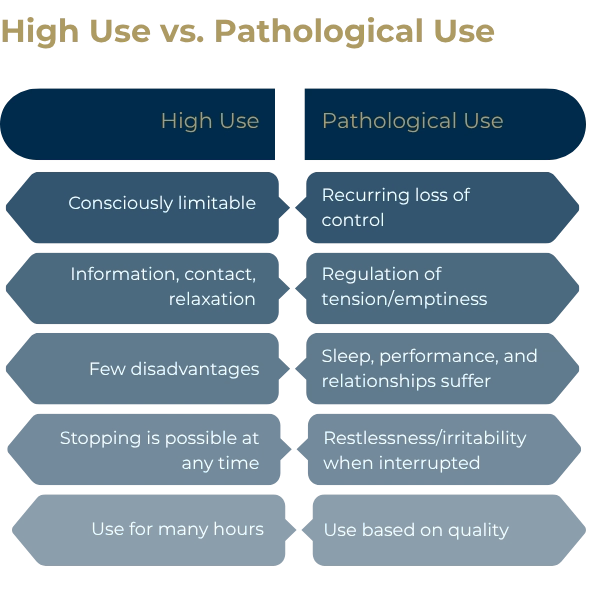
High usage is, first and foremost, a measure of quantity. Pathological use describes a change in quality: persistent loss of control, prioritising digital activity over other areas of life, and continuing despite negative consequences. If you notice that you repeatedly stay online longer than planned, neglect important tasks, lose sleep and feel restless without your device, you should take this seriously and – depending on the severity – seek professional advice.
Does Media Addiction Only Affect Young People?
Problematic use often begins in adolescence but can become entrenched well into adulthood. The consequences are also clearly evident in working life: concentration problems, procrastination, social withdrawal. Media addiction in adults is therefore a highly relevant issue – at every stage of life.