Fear of the Dark in Adults – What Lies Behind Achluophobia
Table of contents
Fear of the Dark: Not Just a Childhood Issue
What Is the Name for the Fear of the Dark? Terms and Classification
2.1 Achluophobia, Nyctophobia and Scotophobia
2.2 When Does Unease Turn Into a Phobia?
Fear of the Dark: Symptoms in Adults
3.1 Physical Reactions
3.2 Thoughts, Feelings and Avoidance
3.3 Effects on Sleep and Daily Life
Causes: Why Adults Develop a Fear of the Dark
4.1 Evolutionary and Biographical Roots
4.2 Distressing Experiences and the Consequences of Trauma
4.3 Fear of the Dark and of Being Alone: When Other Factors Are Involved
Overcoming a Fear of the Dark: What Really Helps
5.1 Exposure Therapy: Regaining the Ability to Cope With Darkness Step by Step
5.2 What You Can Do Yourself in Your Day-to-Day Life
Treatment Options at the LIMES Schlossklinik Bergisches Land
7.1 Is It Normal for an Adult to Be Afraid of the Dark?
7.2 What Is the Difference Between Achluophobia and Nyctophobia?
7.3 Can a Fear of the Dark Go Away on Its Own Without Treatment?
Fear of the Dark: Not Just a Childhood Issue
Many people associate a fear of the dark with childhood: with the night light in the bedroom, the door left ajar and the cautious peek under the bed. What is less well known is that, for some adults, this fear never completely disappears or develops anew over the course of their lives. Those affected can only fall asleep with the light on, avoid walking in the evening, are reluctant to enter an unlit room, or experience a racing heart and a sense of inner alarm in the dark. This often remains hidden from the outside world, as many keep the issue to themselves out of shame.
A certain unease in the dark is normal and can be easily explained in biological terms. However, if the fear is severe and persistent, and if it interferes with daily life, it may be a phobia requiring treatment – known in medical terms as achluophobia or nyctophobia. This article explains how the fear manifests itself, where it might come from, and how to overcome it. First, some reassuring news: specific phobias are classified as anxiety disorders, which are considered to be highly treatable.
What Is the Name for the Fear of the Dark? Terms and Classification
There are several technical terms for the fear of the dark, which are often used interchangeably in everyday language. From a medical point of view, it is not so much the name that matters as the severity of the fear and the extent to which it affects a person’s life.
Achluophobia, Nyctophobia and Scotophobia
The three terms originate from Greek. Essentially, they describe the same phenomenon, but place slightly different emphases:
- Achluophobia
Derived from ‘achlys’ (haze, darkness): the fear of darkness in the strict sense, i.e. of dark rooms and environments. - Nyctophobia
Derived from ‘nyx’ (night): the fear of the night and the darkness of night, often associated with falling asleep. - Scotophobia
Derived from ‘skotos’ (darkness): a rarely used term with a similar meaning.
None of these terms appear as separate diagnoses in the classification systems. A pronounced fear of the dark is classified as a specific phobia – that is, an anxiety disorder relating to a particular object or situation. The ICD-10 even explicitly lists darkness under diagnostic code F40.2 as a possible trigger, alongside heights, animals and flying.
When Does Unease Turn Into a Phobia?
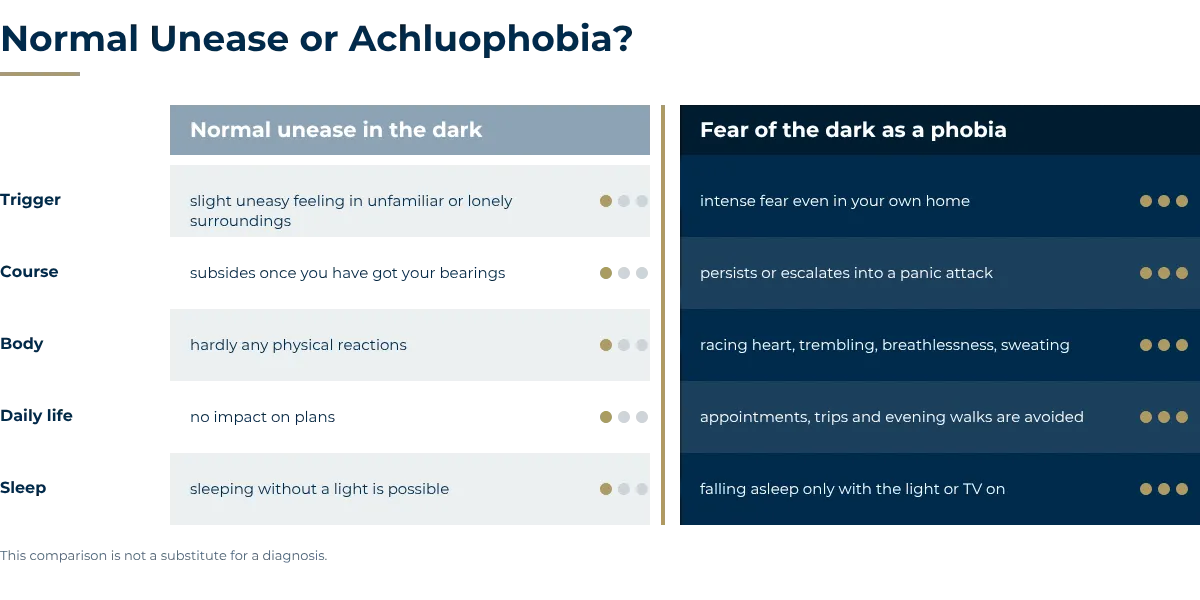
Not every fear of the dark is pathological. Anyone who feels a bit uneasy in the woods at night or prefers to leave a small light on in a stranger’s flat is reacting within the normal range. Experts speak of a phobia when the fear is significantly stronger than the situation warrants, when it persists over a long period of time, and when those affected increasingly organise their lives around avoiding the dark. The German guidelines for the treatment of anxiety disorders emphasise precisely this point: a phobia is only considered a medical condition when the fear or avoidance behaviour significantly impairs everyday life.
The following questions may help with an initial self-assessment. They are not a substitute for a diagnosis by a specialist:
- Have you been falling asleep for months only with the light or the television on?
- Do dark rooms, corridors or cellars make your heart race, cause you to tremble or leave you breathless?
- Do you put off appointments, trips or walks because it might get dark whilst you’re out?
- Do you plan your day so that you’re home before it gets dark?
- Do you think your anxiety is exaggerated, yet still find you can’t control it?
- Is anxiety affecting your sleep, your relationship or your performance?
If you answer ‘yes’ to several of these questions, a consultation with your GP or a psychotherapist would be a sensible next step.
You can find out which conditions we treat in Lindlar in our overview of treatment areas.
Fear of the Dark: Symptoms in Adults
In adults, the fear of the dark rarely manifests itself as merely a vague sense of unease. It typically involves a combination of a physical alarm response, anxious thoughts and behaviours designed to prevent darkness. Often, the symptoms begin even before it is actually dark – for example, in the late afternoon, as daylight fades.
Physical Reactions
In the dark, the brain is deprived of a large proportion of the sensory information it is accustomed to. The nervous system responds to this with increased alertness; in the case of a phobia, this alertness turns into a pronounced stress response. Those affected often report the following symptoms:
- heart palpitations or a racing heart
- rapid, shallow breathing or even shortness of breath
- trembling, sweating and muscle tension
- dizziness or a feeling of light-headedness
- nausea or a feeling of pressure in the stomach
- in severe cases, panic attacks
As these symptoms are very real from a physical point of view, they should be investigated by a doctor when they first appear, for example to rule out cardiovascular disease.
Thoughts, Feelings and Avoidance
On a psychological level, fear is rarely directed at darkness itself, but rather at what it might conceal. Behind this often lies a fundamental fear of losing control: if you cannot see, you cannot assess the situation. Three patterns are particularly common:
- Catastrophic thoughts
Those affected imagine that someone might be in their flat, that something threatening is happening, or that they will be unable to find help in an emergency. - Increased self-monitoring
Every sound and every physical sensation is closely noted and interpreted as a potential warning sign – a cycle that further increases tension. - Safety behaviour
Night lights, lamps left on permanently or a torch within reach provide a short-term sense of security, but perpetuate fear in the long term because they prevent the experience that ‘I can manage without a light’.
Effects on Sleep and Daily Life
The effects are particularly evident when it comes to sleep. People who can only fall asleep with the lights on or who wake up at night with palpitations find it harder to recover; artificial light in the bedroom can also disrupt the natural sleep-wake cycle. Over time, this can lead to sleep disorders, which in turn exacerbate anxiety.
In everyday life, people’s range of activity narrows: evening plans are cancelled, travel is avoided, and in winter some people hardly ever leave the house after work. Many of those affected also feel ashamed because they consider their anxiety to be ‘childish’, and so do not talk to anyone about it. It is precisely this silence that often delays the moment when they seek help.
Causes: Why Adults Develop a Fear of the Dark
As with other specific phobias, there is rarely just one cause for the fear of the dark. In most cases, a combination of genetic predisposition, early learning experiences and current stressors is at play. When the causes are explored in therapy, the focus is not on assigning blame, but on making sense of one’s own experience.
Evolutionary and Biographical Roots
From an evolutionary perspective, being cautious in the dark made sense: people have poor night vision and were once particularly vulnerable in the dark. We therefore presumably have an innate tendency to associate darkness with danger. In children, fear of the dark is one of the typical developmental fears and usually subsides of its own accord.
If the fear persists or returns in adulthood, learning experiences often play a part. These include anxious caregivers who themselves experienced and conveyed the darkness as threatening, or repeated situations in which darkness was associated with being alone and a lack of comfort. A generally heightened level of anxiety can also increase susceptibility to a specific phobia.
Distressing Experiences and the Consequences of Trauma
Sometimes the onset of the fear can be linked to a specific event, such as a burglary, an accident at night or another distressing experience that took place in the dark. Darkness then becomes a trigger that rekindles the threat felt at the time. If this is accompanied by unwanted memories, nightmares or persistent jumpiness, it may be a sign of a post-traumatic stress disorder. In this case, treatment is required that addresses the underlying experience.
Fear of the Dark and of Being Alone: When Other Factors Are Involved
It is not uncommon for a fear of the dark to form part of a wider range of symptoms. In such cases, the dark acts as a catalyst for fears that are kept at bay during the day by distraction and activity. Typical associations include:
- Panic disorder
Anyone who has experienced panic attacks often fears being caught unawares by an attack at night, alone and with no immediate help available. - Generalised anxiety disorder
Worries that accompany you throughout the day become more pressing in the quiet of the evening and make it difficult to fall asleep. - Depression
Low mood and brooding often become more pronounced in the evening and at night; the dark season can make things even harder. - Being alone and life changes
A break-up, the loss of a loved one or a move can mean that evenings and nights are suddenly spent alone. It is precisely the combination of darkness and being alone that can then cause old fears to resurface.
These overlaps are one reason why a thorough diagnosis is so important. It clarifies whether the darkness itself is the main issue or whether another condition should be treated as a priority.
Overcoming a Fear of the Dark: What Really Helps
It is possible to overcome a fear of the dark, even if it has been present for many years. The key is to adopt an approach that gradually reduces avoidance behaviour rather than reinforcing it. Self-help can be beneficial, but it is no substitute for professional treatment in cases of severe symptoms.
Exposure Therapy: Regaining the Ability to Cope With Darkness Step by Step
Cognitive behavioural therapy with exposure is considered the treatment of choice for specific phobias; the German guidelines for the treatment of anxiety disorders assign it the highest level of recommendation. During exposure, also known as confrontation, those affected deliberately and with proper preparation expose themselves to the feared situation until the anxiety noticeably subsides. In this way, the nervous system learns that the feared catastrophe does not materialise. In practice, such an exercise programme might look something like this:
- Together with the treating specialist, the anxiety is described in detail: what is the person afraid of, and what thoughts and physical reactions do they experience?
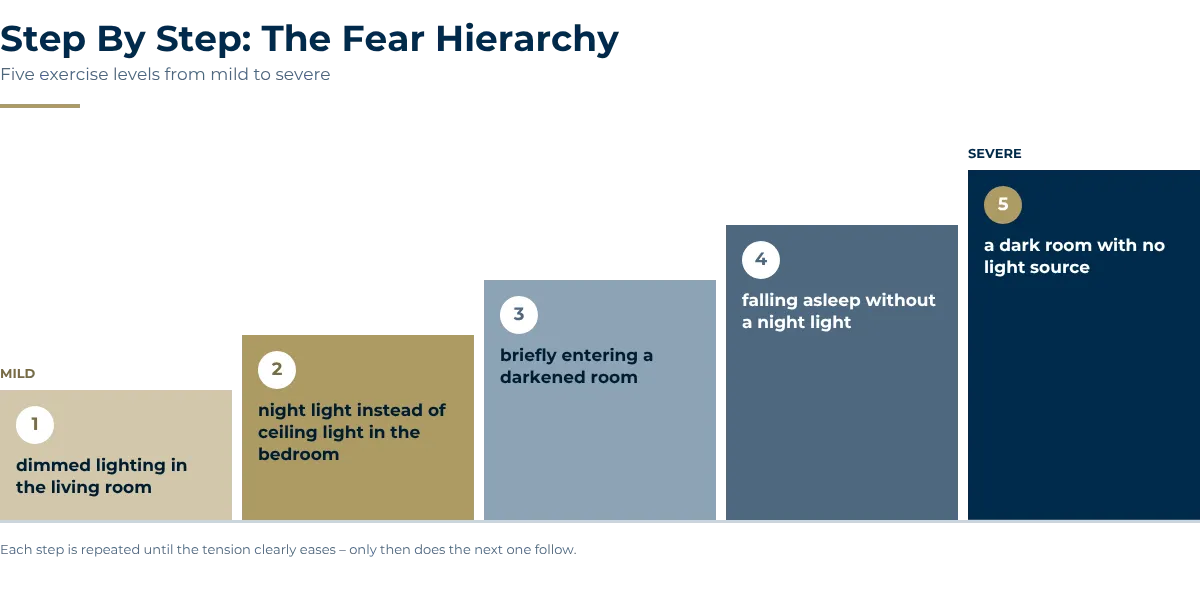
- This results in a hierarchy of fears, that is, a ranking of situations – from mild (dimmed lighting in the living room) to severe (a dark room with no light source).
- The exercises start at the lowest level and are repeated until the tension has clearly eased.
- Safety measures, such as keeping a night light or torch within easy reach, are gradually phased out.
- Only once one stage has been successfully completed does the next follow; any setbacks are discussed and assessed together.
In addition, cognitive techniques can help to challenge catastrophic thoughts, as can psychoeducation, which explains how anxiety arises in the body and subsides again. If the condition is rooted in trauma, trauma-specific approaches such as EMDR may be beneficial. Medication does not usually play a central role in the treatment of a specific phobia; however, in the case of co-occurring conditions, the decision on whether to use it should be left to a doctor.
What You Can Do Yourself in Your Day-to-Day Life
Small, regular steps in everyday life can help prepare for or support treatment. It is important not to take on too much and to be mindful of the progress you make:
- Dim the lights gradually in the evening, rather than leaving them on all night.
- Try breathing exercises or progressive muscle relaxation according to Jacobson to reduce tension before going to bed.
- Write down your fears and check the next day to see which of them actually came true.
- Make sure you maintain a regular sleep-wake cycle and get plenty of daylight, especially during the winter months.
- In the evening, avoid watching disturbing films and the news, and avoid drinking alcohol as a supposed aid to falling asleep.
It is advisable to seek professional help if your anxiety persists for weeks despite your own efforts, if your sleep is consistently affected, or if you find yourself increasingly organising your daily routine around the hours of darkness. The first points of contact are your GP’s surgery and psychotherapy practices. In cases of severe symptoms or multiple concurrent conditions, intensive inpatient treatment may be appropriate.
Treatment Options at the LIMES Schlossklinik Bergisches Land
At the LIMES Schlossklinik Bergisches Land, the process begins with a thorough psychiatric, psychological and psychosomatic assessment. This determines whether the fear of the dark is a specific phobia in its own right or part of a broader psychological condition, such as a panic disorder, depression or a post-traumatic stress disorder. On this basis, we work with you to draw up a personalised treatment plan. Depending on the situation, suitable elements from our range of therapies may include, amongst others:
- High-frequency psychotherapy in individual and group settings
Regular one-to-one sessions provide a space to explore one’s personal history of anxiety; in a group setting, many people affected find that they are not alone in their fears. - Cognitive behavioural therapy and disorder-specific approaches
Anxiety-inducing thoughts are examined, and new experiences of the dark are developed through carefully planned steps. - Psychoeducation
Understanding anxiety, stress responses and sleep helps people to make sense of physical symptoms and perceive them as less threatening. - EMDR
If the anxiety is linked to traumatic experiences, this trauma-focused therapy can help you process those memories. - Relaxation therapy with mindfulness and breathing exercises
Complemented by Jacobson’s progressive muscle relaxation, yoga and qigong, it helps you wind down in the evening. - LIMES Sports.Care
A personalised training programme, developed in collaboration with stress expert and sports medicine specialist Prof. Dr Uwe Nixdorff, which enhances the body’s ability to regulate stress. - Pharmacological treatment and somatic co-treatment
In the case of comorbid conditions, pharmacological support may be considered following a thorough diagnostic assessment; this decision is a matter for the doctor. - Support for relatives and aftercare
Relatives who are involved at the patient’s request learn how they can provide support without reinforcing avoidance; aftercare planning ensures that progress is maintained following the patient’s stay.
The treatment is supported by the Healing Environment at Schloss Heiligenhoven. The architecture, lighting and surrounding parkland are deliberately integrated into the therapeutic concept – an environment that instils a sense of security and can make it easier to have new experiences in the evening and at night. The aim of the treatment is not to abandon all caution in the dark, but to reduce anxiety to such an extent that sleep, evenings and everyday life can once again be organised freely.
FAQs
Is It Normal for an Adult to Be Afraid of the Dark?
A slight unease in dark, unfamiliar surroundings is also common amongst adults and is biologically understandable. Many people, for example, prefer to leave a small light on in unfamiliar rooms. This fear only requires treatment if it is severe, persists over a long period of time and significantly impairs sleep or daily life. In such cases, experts refer to it as a specific phobia, which is considered to be highly treatable.
What Is the Difference Between Achluophobia and Nyctophobia?
Both terms describe a pathological fear of darkness and are generally used interchangeably in everyday language. Achluophobia is derived from the Greek word for mist or darkness and refers more specifically to dark rooms and environments. Nyctophobia comes from the Greek word for night and emphasises the fear of darkness at night. For diagnostic and treatment purposes, the term used makes no difference, as both are classified as specific phobias.
Can a Fear of the Dark Go Away on Its Own Without Treatment?
In children, fear of the dark often resolves itself as they get older. In adults whose fear has persisted for a long time, this is less common, as avoidance and safety-seeking behaviours tend to perpetuate the fear. Mild forms can often be alleviated through gradual self-guided exercises. For severe or persistent symptoms, behavioural therapy involving exposure exercises is considered the treatment of choice.
Kategorien: Anxiety Disorders Sleep Disorders