Emotional Dependency in Relationships: Recognizing Symptoms, Self-Assessment, and How to Break Free
Contents
The Most Important Points in Brief
2.1 Emotional Attachment Vs. Emotional Dependence
Emotional Dependence In a Relationship: Symptoms & Checklist
3.1 Checklist: Signs of Emotional Dependence
Emotional Dependence After a Break-Up
4.1 Typical Reactions Following a Break-Up
4.2 First Steps Towards Finding Peace of Mind After a Break-Up
How Do Childhood Experiences Shape Emotional Dependence?
Long-Term Consequences For Relationships
6.1 Patterns Such As Self-Sacrifice, Fear of Loss And Clingy Behaviour
6.2 Repetition of Early Attachment Patterns In Adult Relationships
Overcoming Emotional Dependence: Steps Towards Change
Treatment For Emotional Dependence At The LIMES Schlossklinik Bergisches Land
9.1 What are the typical symptoms of emotional dependence?
9.2 How long does emotional dependence last after a break-up?
9.3 Can you overcome emotional dependence on your own, or do you need therapy?
Do you often feel insecure in relationships, or do you cling to your partner for fear of being abandoned? Emotional dependence is particularly evident in relationships – and often even more so following a break-up. In this article, you’ll learn how to recognise emotional dependence, what the typical symptoms are, why the causes often lie in childhood, and what steps and therapeutic treatment methods can help you break free from it.
The most important points in brief
- Emotional dependence refers to a strong psychological bond in which one’s own well-being depends almost entirely on the partner’s approval and affection.
- Typical symptoms include fear of loss, clingy behaviour, self-sacrifice, jealousy and difficulty being alone.
- Following a break-up, those affected often experience this dependency particularly intensely – with feelings of withdrawal, rumination and the urge to re-establish contact.
- The causes often lie in insecure or ambivalent attachments, as well as traumatic experiences in childhood.
- Emotional dependence can be overcome – through self-reflection, building self-esteem, setting healthy boundaries and seeking professional support.
What is emotional dependence?
Emotional dependence describes the strong need to make one’s own well-being dependent on another person or relationship. It often stems from a lack of self-esteem and leads to one’s own needs being put on the back burner in favour of others. It is important to understand the difference between emotional attachment and dependence, and to recognise the typical characteristics and the impact on the lives of those affected.
Emotional Attachment Vs. Emotional Dependence
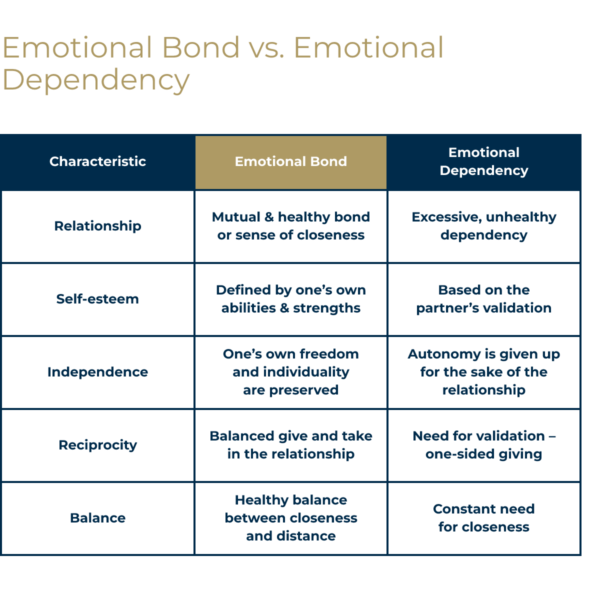
Emotional attachment represents a healthy bond with other people, based on equality. It is characterised by mutual trust, respect and support. The partners in this relationship are not dependent on one another, but are able to meet their own needs independently. Emotional dependence, on the other hand, is characterised by an excessive need for attention and validation from one’s partner.
Emotional dependence in relationships: symptoms & checklist
People who have experienced emotional trauma, neglect or unstable attachments during their childhood often develop patterns of emotional dependency that become deeply ingrained in their later relationships. These patterns manifest themselves through a series of characteristic symptoms that can severely impair both their own well-being and the quality of their relationship.
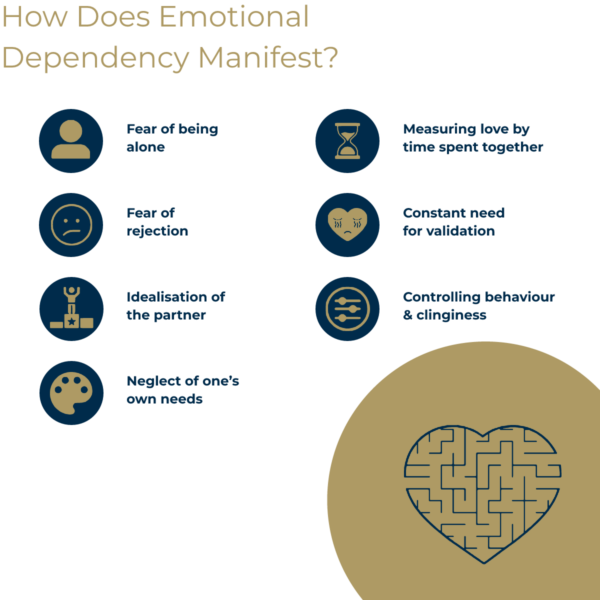
- A constant need for validation and attention: Those affected are often unable to stabilise their own emotions and rely on constant attention and recognition from their partner to feel valued and loved.
- Constant fear of rejection and abandonment: This deep-seated fear of loss often stems from early attachment experiences and leads to constant worry about not being good enough – even without any real cause.
- Loss of self-esteem: One’s self-image is heavily dependent on the partner’s reaction. Criticism, arguments or emotional distance are quickly perceived as personal failure.
- Putting one’s own needs second: Emotionally dependent people adapt excessively, rarely say ‘no’ and pay little attention to their own wishes or boundaries – for fear of losing their partner.
- Difficulty making decisions alone: Decisions are often delegated to the partner or made only with great uncertainty, out of fear of making mistakes or being rejected.
- Jealousy and controlling behaviour: Because emotional security depends so heavily on the partner, intense feelings of jealousy arise, along with attempts to control the other person.
- Difficulty being alone: Being alone is perceived as threatening. Separations, even brief ones, can trigger severe emotional crises.
- One-sided relationship dynamics: One person gives, adapts and makes sacrifices, whilst the other increasingly takes control or distances themselves – the relationship can take on toxic traits.
Checklist: Signs of Emotional Dependence
The more of the following statements apply to you, the more likely it is that you are caught in an emotionally dependent relationship pattern:
- My well-being depends almost entirely on how my partner behaves.
- I am very afraid of being abandoned – even without any specific reason.
- I almost always put my own needs last.
- I find being alone very difficult or frightening.
- I need constant reassurance to feel secure.
- I control my partner or frequently ask where they are.
- After an argument, I feel worthless until we make up.
This checklist is no substitute for a diagnosis, but it can serve as a starting point for reflecting on your own behaviour.
Emotional Dependence Following a Break-Up
Following a break-up, emotionally dependent people often experience this dependence particularly intensely. Because their own well-being was so closely tied to the relationship, the end of the partnership can feel like withdrawal – with physical and emotional reactions that can go far beyond normal grief.
Typical Reactions Following a Break-Up
- Intense rumination and the urge to think constantly about the ex-partner.
- A strong need to re-establish contact or save the relationship.
- Feelings of inner emptiness, worthlessness or a loss of direction.
- Sleep disturbances, loss of appetite and other psychosomatic symptoms.
- A tendency to seek a new relationship very quickly in order to fill the void.
First Steps Towards Finding Peace After a Break-Up
- Take breaks from contact: distance creates space for emotional regulation.
- Consciously structure your daily life and establish stabilising routines.
- Actively involve your social circle and accept support.
- Gradually reclaim your own needs and neglected interests.
If the break-up remains almost unbearable for weeks on end, or if patterns repeat themselves in every relationship, this may indicate love addiction. Professional support can help break the cycle.
How Do Childhood Experiences Shape Emotional Dependence?
Emotional dependence often has its roots in the early years of life, long before the symptoms become apparent in adulthood. The way in which children experience attachment, how their needs are met or overlooked, and how emotionally available their caregivers are, has a lasting impact on their self-image and their behaviour in relationships. If security, validation or affection are lacking, the child may learn to link love to performance or conformity – a pattern that later manifests as emotional dependence.
- Trauma: Traumatic experiences such as abuse, neglect or insecure attachments can lead to emotional dependency. In particularly extreme cases, this can result in ‘trauma bonding’, whereby strong bonds develop with the abuser despite the mistreatment. Coming to terms with such experiences is a central component of trauma therapy.
- Parental divorce or separation: Parental divorce or separation is associated with insecurity, fear of loss and feelings of rejection. As a result, children often develop fears of loss that influence their later lives and make it difficult for them to form healthy relationships and set healthy emotional boundaries.
- Parentification: In parentification, children take on parental roles and meet their parents’ needs. They often neglect their own needs and find it difficult to set healthy boundaries. In adulthood, these individuals tend to have low self-esteem and be co-dependent.
Long-Term Consequences For Relationships
Emotional dependency often leads to an inner conflict between the desire for closeness and the need for autonomy. Those affected seek intense validation, yet find it difficult to develop independence – a vicious circle of fear of loss and loss of self.
Patterns Such As Self-Sacrifice, Fear of Loss and Clingy Behaviour
Those affected prioritise their partner’s needs over their own, which can lead to exhaustion and psychosomatic symptoms such as sleep disturbances and headaches. Fear of loss manifests itself in a constant fear of being abandoned, excessive clinging and a constant search for reassurance – behaviours that can alienate the partner in the long term.
Repetition of Early Attachment Patterns in Adult Relationships
Insecure attachments from childhood can lead those affected to either cling intensely or withdraw emotionally. These behaviours fuel fear of loss, self-sacrifice and toxic relationship patterns, particularly when traumatic experiences are a underlying factor.
If, in addition to emotional dependence, compulsive patterns of behaviour are evident in relationships or sexual activity, specialised treatment for sex and love addiction may be advisable.
Overcoming Emotional Dependence: Steps Towards Change
Overcoming emotional dependence begins with reflecting on your own patterns, building self-esteem and setting healthy boundaries. The following steps will help you to initiate the first changes on your own.
- Recognising your own patterns
- Observe your behaviour in relationships and document recurring patterns.
- Reflect on which needs are frequently neglected and which are met by others.
- Question beliefs such as ‘I am not lovable’ or ‘I cannot be happy without others’.
- Boost your self-esteem
- Practise self-love and self-acceptance, and consciously recognise your own strengths and achievements.
- Pursue interests and hobbies that bring joy and boost self-confidence.
- Replace negative beliefs with empowering, positive affirmations.
- Set healthy boundaries
- Learn to communicate your needs clearly and respectfully.
- Practise saying ‘no’ to protect your own autonomy.
- Build a stable social circle outside your relationship.
- Practise patience and self-care
- Accept that change is a process that takes time.
- Practise regular physical and emotional self-care.
- Consciously celebrate small successes to boost motivation.
When self-help reaches its limits, seeking professional support is the next sensible step. The LIMES Schlossklinik Bergisches Land offers specialised help for love addiction and emotional dependency.
Treatment For Emotional Dependency at the LIMES Schlossklinik Bergisches Land
Therapy and Inner Child work can play a crucial role in helping patients overcome emotional dependency. Therapeutic support strengthens self-esteem and promotes the development of an independent identity. At the LIMES Schlossklinik Bergisches Land, we combine various methods to create a personalised treatment plan.
- Psychotherapy based on depth psychology: Identifying and addressing unconscious conflicts and early attachment experiences that underlie the dependency.
- Inner Child work: Building a loving, supportive relationship with the inner child and healing unmet needs from childhood – ideally under professional guidance.
- Cognitive behavioural therapy: Recognising and changing negative beliefs, and building healthy relationship and thought patterns.
- Trauma and attachment therapy: Processing distressing experiences that reinforce emotional dependence and co-dependence.
- Group and individual therapy: Sharing experiences, strengthening self-esteem and practising healthy closeness and boundaries.
A detailed description of the treatment services available can be found here.
Conclusion: Seek professional help – for a self-determined life!
Emotional dependence is deeply rooted and often the result of traumatic childhood experiences. It undermines self-esteem, makes healthy relationships difficult and is particularly evident following a break-up. It is possible to work through these issues – through conscious self-reflection, recognising your own patterns and, above all, with professional support. Our specialists at the LIMES Schlossklinik Bergisches Land will provide you with empathetic support on your journey towards greater emotional freedom. Please feel free to get in touch with us.
FAQ
What are the typical symptoms of emotional dependence?
The most common symptoms include a constant need for reassurance, a strong fear of loss, self-sacrifice, jealousy and controlling behaviour, as well as difficulty being alone. One’s own sense of well-being depends almost entirely on the partner’s reaction.
How long does emotional dependence last after a break-up?
This varies greatly from person to person. The first few weeks are often the most intense, as the end of the relationship can feel like withdrawal. With breaks from contact, stabilising routines and support, the acute pressure usually eases. If the emotional distress persists for months or if the pattern repeats itself in every relationship, it is advisable to seek professional help.
Can you overcome emotional dependence on your own, or do you need therapy?
The first steps – such as self-reflection, building self-esteem and setting healthy boundaries – can be taken independently. If the patterns are deeply ingrained – for example, due to distressing childhood experiences or trauma – therapeutic support is the most effective way to address the root causes in the long term.

Kategorien: Trauma