Tinnitus Caused By Stress – Understanding The Psychological Links
Background: What Is the Link Between Tinnitus and Stress?
1.1 What Is Tinnitus? Types and Perception
1.2 How Stress Can Intensify the Perception of Tinnitus
Psychological Links: Why the Mind Can Make the Sound Louder
2.1 Stress, Anxiety, Sleep – a Vicious Circle
2.2 Depressive Symptoms, Trauma and Exhaustion
2.3 Work-Related Stress, Perfectionism and Hypervigilance
Identifying the Causes of Tinnitus: Determining What Needs to Be Clarified
3.1 Pulse-Synchronous Tinnitus: Stress as an Exacerbating Factor, Not the Sole Cause
3.2 Other Causes and Risk Factors
3.3 Warning Signs Requiring Immediate Medical Assessment
Assessing the Impact, Developing Perspectives
4.1 Short-Term Relief: Small Steps, Clear Guidance
4.2 Managing Work and Everyday Stress
4.3 When Professional Help Is Advisable
Treatment at the LIMES Schlossklinik Bergisches Land
5.1 Treatment Methods
6.1 Does Stress-Related Tinnitus Go Away?
6.2 What Is Pulse-Synchronous Tinnitus Caused by Stress – and When Should I See a Doctor?
6.3 What Role Do Caffeine, Alcohol and Medication Play?
Background: What Is the Link Between Tinnitus and Stress?
Tinnitus refers to hearing sounds without an external sound source – often described as whistling, hissing or humming. Many sufferers report that the noises in their ears intensify during periods of high stress and seek explanations for this link. From a technical perspective, it is clear that stress does not always cause tinnitus, but it can significantly influence how it is perceived and the distress it causes.
The causes of tinnitus cover a broad spectrum – ranging from changes in the auditory system to circulatory factors and psychological stress. Tinnitus caused by stress is therefore just one possible explanation amongst many. At the same time, stress can trigger cycles that perpetuate the ringing in the ears. Understanding these interactions enables people to take more targeted countermeasures and assess their own situation realistically.
What Is Tinnitus? Types and Perception
Tinnitus can be acute (lasting from days to a few weeks) or chronic (lasting longer than three to six months). Some people hear a tone, others a hissing or thumping sound. It can affect one or both ears, and the volume may be constant or fluctuate. A special case is so-called pulse-synchronous tinnitus, in which the sound appears to mirror the heartbeat. From a medical point of view, pulse-synchronous tinnitus caused by stress is unlikely to be the sole cause – however, stress can intensify the perception of the sound.
A medical assessment is always important in cases of pulse-synchronous sounds.
How loud a sound is perceived to be does not depend solely on the signal strength in the auditory system. Expectations, attention, mood and tension all influence perception. For example, tinnitus may seem louder when under stress, as stress increases the body’s internal state of alertness. Conversely, quiet periods with good distractions are often experienced as a relief.
How Stress Can Intensify the Perception of Tinnitus
Stress activates the autonomic nervous system: heart rate and muscle tone increase, whilst attention filters focus on potential threats. In this state, tinnitus encounters a system that detects stimuli more quickly and evaluates them more intensely. This often leads to a cycle of tension, rumination and avoidance behaviour. The following amplifying mechanisms, which characterise the link between tinnitus and stress in everyday life, are typical:
- Attention as a volume control
The more you focus on a sound, the more dominant it feels. - Assessment and significance
Those who perceive the sound as dangerous or as a threat to their sense of control react with greater fear and tension. - Physical tension
Tension in the neck and jaw area can further influence perception. - Sleep and rest
Poor sleep lowers the tolerance threshold and increases stress reactivity, making the noise seem more distressing.
Psychological Links: Why the Mind Can Make the Sound Louder
Tinnitus often arises from a combination of physical and psychological factors. In the brain, auditory centres are closely linked to emotional and attentional networks. When stress, anxiety or depressive mood are present, stimuli are perceived more intensely – the ringing in the ears becomes more prominent. This psychological component explains why two people with similar diagnoses can experience the condition very differently.
The following psychological factors are particularly relevant here:
- Anxiety and a heightened sense of alertness
A persistently elevated level of tension makes the ringing in the ears seem more threatening than it needs to be. - Depressive mood
A negative outlook and a sense of hopelessness make it harder to perceive the noise as tolerable. - Chronic fatigue
People who consistently fail to get enough rest are more likely to perceive auditory stimuli as overwhelming. - Perfectionism and self-criticism
High personal standards foster constant tension and make coping with tinnitus even more stressful.
Personality and behavioural patterns also play a role. At the same time, it is important to note that such a connection does not mean that everything is psychological. Rather, the body and mind influence one another.
Stress, Anxiety, Sleep – a Vicious Circle
Fear of the noise, night-time rumination and tension often lead to sleep disturbances. Fatigue, in turn, reduces resilience, making the noise seem more prominent. In many cases, this creates a cycle in which tinnitus is perceived more intensely due to stress – and the stress increases further as a result of the ringing in the ears. The aim of psychotherapeutic treatment is to break this cycle.
A practical approach involves a combination of psychoeducation, attention redirection and stress management. This strengthens the sense of control and reduces the constant threat assessment by the brain’s alarm network.
Depressive Symptoms, Trauma and Exhaustion
Depressive episodes, adjustment disorders or post-traumatic stress reactions can exacerbate the perception of tinnitus. Negative thought patterns diminish hope and motivation to try out helpful strategies. Appropriate therapy can not only alleviate the underlying psychological distress but also indirectly reduce the burden of tinnitus.
Physical exhaustion, in the sense of a burnout also has an impact: those who do not get enough rest often find auditory stimuli overwhelming more quickly. This is where stress prevention comes in – a key component in breaking this cycle in the long term.
Work-related Stress, Perfectionism and Hypervigilance
High performance expectations, constant availability and a lack of time to relax contribute to chronic tension. This promotes hypervigilance – an excessive state of inner alertness – which causes even faint bodily sounds to come to the fore. Stress-related tinnitus then becomes the focal point, consuming a great deal of mental energy. Targeted training in realistic self-management – for example, through prioritising, taking micro-breaks and establishing clear transitions between work and leisure – can provide relief here.
Not all sources of stress can be avoided. But many can be managed in such a way that less involuntary attention is paid to the ringing in the ears.
Identifying the Causes of Tinnitus: Determining What Needs to Be Clarified
Before focusing on psychosomatic and psychotherapeutic approaches, the causes should be assessed by a specialist – typically through an ENT examination, supplemented where necessary by a hearing test, imaging diagnostics or a dental and orthodontic assessment. This is particularly important if the ringing in the ears is new, has changed or is accompanied by other symptoms.
It is important to distinguish between tinnitus caused by stress – that is, a marked worsening due to psychological strain – and tinnitus resulting from primarily organic causes, such as following noise-induced trauma or in cases of hearing loss. Mixed forms are often present. Stress management does not address the underlying cause in such cases, but can significantly reduce the psychological burden.
Pulse-synchronous Tinnitus: Stress as an Exacerbating Factor, Not the Sole Cause
Pulse-synchronous tinnitus is perceived in time with the heartbeat. This may be caused by harmless factors, but may also be due to conditions requiring treatment, such as circulatory abnormalities or narrowing of the blood vessels. Stress can intensify the sensation, but is rarely the sole cause. It is therefore important to seek medical advice if you experience pulse-synchronous noises, even if they become more pronounced during periods of stress.
Once relevant physical causes have been ruled out, psychosomatic treatment can help to regulate the interplay of attention, perception and tension. This often allows pulse-synchronous sounds to be experienced as less threatening.
Other Causes and Risk Factors
As well as psychological stress, tinnitus can also be triggered or exacerbated by organic factors. The most common of these include:
- Noise or impact trauma
Sudden or prolonged exposure to noise can damage hair cells and trigger tinnitus. - Age-related hearing loss
As we get older, the inner ear changes, which can increase the likelihood of developing tinnitus. - Middle ear infections
Inflammatory processes in the ear can impair sound processing. - Temporomandibular joint and neck muscles
Disorders of the temporomandibular joint or muscle tension in the neck and shoulders can influence the perception of tinnitus. - Medicines
Some painkillers in high doses, as well as other active ingredients, can trigger or exacerbate tinnitus. - Fluctuations in blood pressure and metabolic disorders
Circulatory changes or systemic conditions may also play a role.
These factors can occur independently of psychological stress. Nevertheless, experience shows that stress can be reduced through targeted stress management – even if an organic cause persists.
Warning Signs Requiring Immediate Medical Assessment
There are situations in which prompt medical consultation is essential. Ensure you have an ENT examination carried out as soon as possible if any of the following warning signs occur:
- Sudden, unilateral hearing loss
- Severe bouts of vertigo
- Neurological deficits (e.g. numbness, visual disturbances)
- A newly developed pulsatile noise
- Significant deterioration in hearing over a short period
Once organic causes have been ruled out, the next step is to examine the individual combination of physical and psychological factors.

Assessing the Impact, Developing Perspectives
Many people ask themselves: Will stress-related tinnitus go away? There is no one-size-fits-all answer. In acute phases, such as following an exceptional source of stress, stress-related tinnitus may well subside or become significantly less severe. In cases of long-standing tinnitus, the burden can often be noticeably reduced if stress management, sleep, mindfulness and cognitive reappraisal are systematically practised. This connection is both a starting point and an opportunity.
A favourable prognosis is associated with early treatment, realistic expectations and a personalised combination of medical assessment, psychoeducation and practical everyday strategies. This does not mean ignoring stress-induced tinnitus, but the brain can learn to perceive the sound less as an alarm signal.
Short-term Relief: Small Steps, Clear Guidance
During acute periods of stress, small, reliable steps often help more than major upheavals. The aim is to reduce the intensity of the internal alarm and to maintain flexible attention. It makes sense to adopt approaches that realistically fit into your everyday life and do not cause additional stress.
- Use breathing and mindfulness exercises in moderation
Short, regular sessions often have a more stabilising effect than long, infrequent ones. - Use gentle background sounds
Soft white noise, nature sounds or music can mask the tinnitus without being overwhelming. - Improve sleep hygiene
Fixed bedtimes, switching off screens in the evening and creating a quiet sleeping environment help to promote rest. - Exercise as a stress buffer
Going for a walk, moderate endurance exercise or gentle stretching help regulate the nervous system. - Seek social support
Open conversations help relieve pressure – but avoid making tinnitus a constant topic of conversation.
If strategies cause additional stress, it is worth seeking support from specialists.
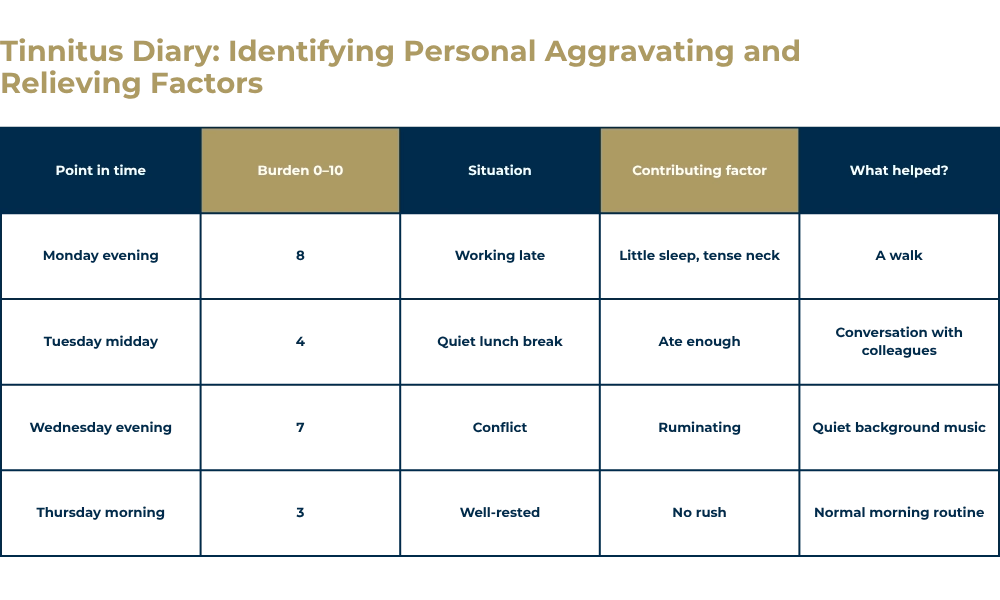
Managing Work and Everyday Stress
Constant overload heightens your perception of tinnitus. Small, consistent adjustments to your daily routine can significantly reduce internal tension:
- Establish clear boundaries between work and leisure
Fixed rituals at the end of the working day help the body switch into recovery mode. - Schedule micro-breaks
Short breaks spread throughout the day are often more effective than a single long rest at the weekend. - Consciously limit your availability
Setting aside specific times when you are not available for work protects the rest periods you need. - Question your expectations of perfection
Excessive personal expectations increase internal pressure. Realistic prioritisation can provide noticeable relief.
If your environment is very demanding, clear agreements can help. Sometimes, even a temporary reduction in stress can provide the necessary opportunity for recovery to break the cycle.
When Professional Help Is Advisable
At the very latest when anxiety, rumination, sleep problems or depressive symptoms persist or worsen, it makes sense to seek professional help. This also applies if you notice that you are increasingly organising your daily life around the tinnitus. The sooner support is provided, the better flexible, sustainable coping strategies can be established.
Discover our wide range of therapies and find out which treatment is suitable for your situation.
Treatment at the Limes Schlossklinik Bergisches Land
At the LIMES Schlossklinik Bergisches Land , we treat psychological and psychosomatic conditions that often accompany tinnitus – for example, stress-related disorders, anxiety, sleep disorders or depressive episodes. Once a doctor has ruled out any potential organic causes, the focus is on a multimodal approach: we combine psychotherapeutic, psychosomatic and body-oriented therapeutic methods to reduce the individual’s psychological burden and strengthen their self-regulation.
The treatment is always tailored to the individual. Some patients benefit most from psychoeducation and cognitive behavioural therapy, whilst others benefit from mindfulness-based and body-oriented approaches. In most cases, the psychological factors exacerbating tinnitus can be effectively managed.
Treatment Methods
Depending on the individual findings and the patient’s level of distress, treatment comprises a combination of different approaches. The focus is always on identifying which factors are perpetuating the tinnitus-related distress in each specific case – and how these can be specifically addressed. Some patients benefit most from psychotherapeutic work on cognitive distortions and attentional processes, whilst others initially require physical relief or greater stability in their daily lives. Typical components of our treatment approach are:
- Psychiatric and psychosomatic assessment
At the outset, we carry out a comprehensive assessment to identify the factors that perpetuate the impact of tinnitus – psychological, physical and in everyday life. This forms the basis for a personalised treatment plan with specific, achievable goals. - High-frequency psychotherapy
In both individual and group settings, we use methods from cognitive behavioural therapy and Acceptance and Commitment Therapy (ACT) to change distressing patterns of thought and behaviour. - Psychoeducation
Those affected learn how attention, evaluation and stress reactivity influence the perception of tinnitus – and how they can actively break this cycle. - Relaxation and body-based therapies
Breathing exercises, progressive muscle relaxation, yoga and qi gong help to regulate the nervous system. Where necessary, physiotherapy addresses muscular imbalances in the neck and jaw area. - LIMES Sports.Care
A personalised exercise programme helps to reduce stress, build physical resilience and restore the body’s ability to recover. - Daily Routine and Social Environment
Stable daily routines and – where appropriate – couple or family discussions make it easier to apply what has been learnt to everyday life following a stay in hospital.
FAQ
Does Stress-related Tinnitus Go Away?
In some cases, particularly when it occurs acutely in the context of exceptional stress, stress-related tinnitus can subside. Often, the burden can be noticeably reduced through targeted training in stress management, sleep hygiene, attention control and the way the sound is perceived. There is no guarantee – the individual outcome depends on the cause, duration, any underlying conditions and the consistent application of effective strategies.
What Is Pulse-synchronous Tinnitus Caused by Stress – and When Should I See a Doctor?
Pulse-synchronous tinnitus is perceived in time with the heartbeat. Stress can intensify this perception, but is rarely the sole cause. As there may also be underlying vascular or circulatory causes requiring treatment, pulse-synchronous tinnitus should always be investigated by a doctor – particularly if it is a new onset, changes rapidly or is accompanied by other symptoms.
What Role Do Caffeine, Alcohol and Medication Play?
The effect varies from person to person. In some people, caffeine can increase internal arousal and thus intensify the perception of tinnitus; for others, it plays hardly any role at all. Alcohol can have a short-term sedative effect, but it often disrupts sleep – which increases the burden the following day. Some medicines can affect tinnitus; never stop taking any medication on your own, but speak to your doctor about possible alternatives.