Recognising Burnout in Managers – Early Warning Signs, Risks and Professional Help
Table of Contents
Burnout Among Executives – When Responsibility Becomes a Constant Burden
1.1 Why Burnout Affects Managers Particularly Frequently
1.2 The Specific Psychological Dynamics Among Managers and Those in Senior Positions
1.3 Burnout as a Gradual Process Rather Than a Sudden Breakdown
1.4 Distinguishing It From Stress, Depression and Exhaustion Syndromes
Recognising Warning Signs: How Burnout Manifests Itself in Day-to-day Management
2.1 Mental and Emotional Changes in Managers
2.2 Physical Symptoms as Early Indicators of Stress
Causes of Burnout Among Managers and Executives
3.1 Constant Decision-making Responsibility and a Lack of Recovery Periods
3.2 Internal Drivers Such as Perfectionism, a Sense of Duty and a Need for Control
3.3 Structural Pressures Arising From Organisation, Hierarchies and Expectations
Consequences of Untreated Burnout
4.1 Consequences for Mental and Physical Health
4.2 Effects on Leadership Style, Team Dynamics and Working Atmosphere
4.3 Long-term Risks to Career, Relationships and Quality of Life
4.4 Why Early Intervention Is Crucial
Treatment Methods at the LIMES Schlossklinik Bergisches Land
6.1 How Can Burnout Be Distinguished From Depression in Managers?
6.2 Is Inpatient Treatment Also an Option for Managers Who Are Heavily Involved in Their Work?
6.3 What Role Does Discretion Play in Treatment at a Private Burnout Clinic?
Burnout Among Executives – When Responsibility Becomes a Constant Burden
Burnout is no longer a marginal phenomenon, but increasingly affects people in positions of responsibility. Executives in particular are under considerable pressure: they are not only responsible for their own performance, but also for decisions, teams, financial results and, often, the well-being of entire organisations. This constant, multi-faceted strain can lead to a creeping state of exhaustion that goes unnoticed for a long time.
Why Burnout Affects Managers Particularly Frequently
In their day-to-day working lives, managers are confronted with a multitude of demands that reinforce one another. Burnout rarely arises from a single trigger, but rather from the long-term interplay of several stress factors:
- High levels of responsibility and pressure to make decisions
Managers regularly have to make decisions with far-reaching consequences. The fear of making the wrong decisions, suffering financial losses or facing interpersonal conflicts leads to constant inner tension, leaving little room for relief.
- Constant availability and a lack of boundaries
Many managers are available even outside working hours. Work-related issues encroach on private downtime, making genuine recovery increasingly difficult.
- Emotional strain from managing staff
Conflict resolution, performance appraisals or personnel decisions require emotional stability and self-control. Personal stress is often put on the back burner in order to function professionally.
- High expectations from others and from oneself
Alongside external expectations, internal performance standards play a central role. The desire to be confident, resilient and high-performing at all times increases the risk of ignoring warning signs.
This combination makes managers particularly vulnerable to burnout, as the pressures they face are not only intense but, above all, persistent.
The Specific Psychological Dynamics Among Managers and Those in Senior Positions
Burnout amongst managers often follows its own psychological dynamics. Many of those affected have learnt to manage stress, shoulder responsibility and tackle problems in a solution-oriented way. Whilst these skills are helpful in day-to-day working life, they can lead to people compensating for excessive demands for a long time.
Furthermore, weakness or exhaustion is frequently interpreted as a personal failure. Instead of seeking support, many managers try to cope with the pressures on their own. Emotional detachment, a sense of inner emptiness or increasing irritability are rationalised or suppressed until the situation deteriorates significantly.
Burnout as a Gradual Process Rather Than a Sudden Breakdown
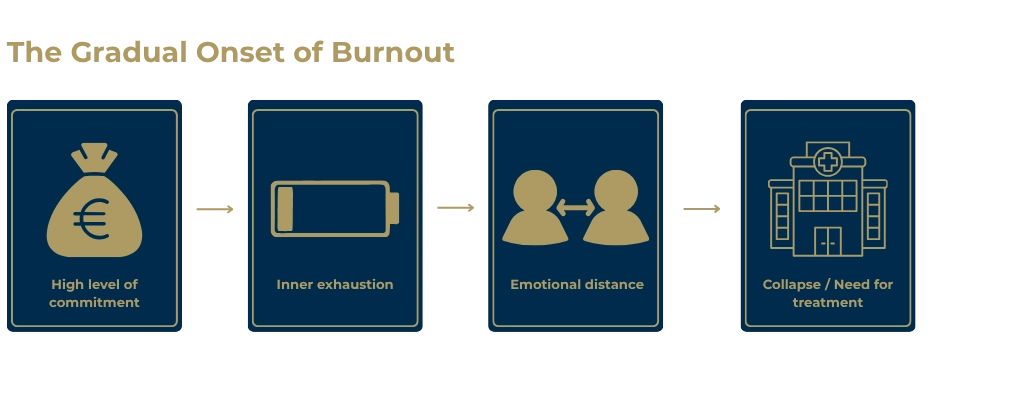
Burnout does not usually develop abruptly, but over a prolonged period. Among managers in particular, this process often goes unnoticed, as performance initially remains the same or even improves. Typical phases may include:
- Phase of over-adaptation and increased performance
Initially, increasing demands are offset by greater effort. Breaks are cut back and the need for rest is ignored, whilst professional success appears to remain stable.
- Phase of inner exhaustion
Over time, emotional fatigue, problems concentrating and a feeling of inner emptiness set in. Work becomes increasingly draining, and joy and motivation noticeably decline.
- Phase of withdrawal and detachment
Those affected develop an emotional distance from their work, colleagues or staff. Cynical thoughts, indifference or a noticeable sense of detachment may arise.
- Phase of overt exhaustion
Eventually, physical symptoms often set in, such as sleep disturbances, chronic exhaustion or psychosomatic complaints. Work performance declines progressively.
Precisely because this progression is gradual, burnout in managers is often only recognised at a late stage.
Distinguishing It From Stress, Depression and Exhaustion Syndromes
Not every form of stress or tiredness automatically constitutes burnout. Short-term periods of stress are a normal part of a manager’s working life and can usually be managed effectively. Burnout differs in that the exhaustion becomes chronic and extends across several areas of life.
Unlike depression, burnout is initially centred on the professional context. Nevertheless, the two conditions can overlap or merge into one another, which is why a specialist medical assessment is particularly important. A clear diagnostic classification forms the basis for targeted and effective treatment.
Recognising Warning Signs: How Burnout Manifests Itself in Day-to-day Management
Burnout often develops unnoticed in managers. Precisely because many of those affected remain productive for a long time, the first signs are often misinterpreted or deliberately ignored. This makes it all the more important to take early warning signs seriously and interpret them correctly.
Mental and Emotional Changes in Managers
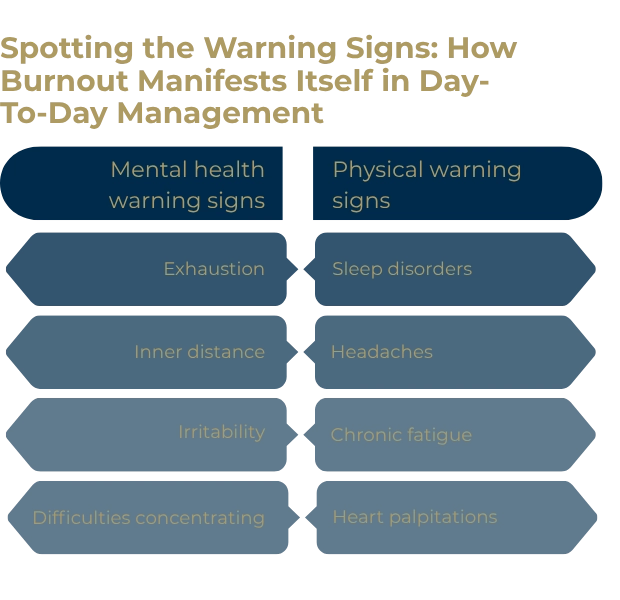
Among the first signs of incipient burnout are often changes in emotional experience and thought processes. Managers increasingly report inner tension, irritability or a feeling of being constantly overwhelmed. Tasks that were once handled routinely are now experienced as burdensome or pointless.
Another typical symptom is a waning interest in work-related matters, coupled with a sense of detachment from one’s own role. It becomes harder to make decisions, and confidence in one’s own competence wanes. At the same time, there is often an internal pressure to keep functioning, which further exacerbates emotional exhaustion.
It is not uncommon for this to lead to sleep problems, ruminative thoughts or a feeling of constant inner restlessness. Emotions such as joy, motivation or satisfaction increasingly fade into the background.
Physical Symptoms as Early Indicators of Stress
Burnout does not manifest itself solely on a psychological level. The body often sends early warning signals, but these are overlooked or downplayed in the hectic day-to-day life of a manager. Persistent tiredness despite getting enough sleep, feeling exhausted first thing in the morning, or a general sense of physical weakness are typical signs.
These are often accompanied by psychosomatic symptoms such as headaches, gastrointestinal problems, muscle tension or a heightened sense of susceptibility to infection. Cardiovascular symptoms such as palpitations or fluctuations in blood pressure may also occur.
These physical symptoms are a manifestation of chronic stress and should not be viewed in isolation. Managers in particular, who are accustomed to pushing themselves beyond their limits, are at high risk of ignoring these signals until their condition deteriorates significantly.
Causes of Burnout Among Managers and Executives
Burnout among managers rarely occurs by chance. It is usually the result of persistent stress that builds up over months or years. Professional demands, personal characteristics and structural conditions all interplay in this process.
Constant Decision-making Responsibility and a Lack of Recovery Periods
Managers make decisions every day that can have far-reaching consequences. This ongoing responsibility creates constant internal pressure that is rarely fully relieved. Added to this is the fact that decision-making processes often take place under time pressure, uncertainty or conflicting expectations.
At the same time, many managers lack clear periods of rest. Breaks are cut short, holidays are not fully enjoyed or are skipped altogether. The boundary between working hours and leisure time is becoming increasingly blurred, leaving the nervous system with little opportunity to return to a state of sustained relaxation. The result is chronic stress, which has an exhausting effect in the long term.
Internal Drivers Such as Perfectionism, a Sense of Duty and a Need for Control
Alongside external demands, personal factors play a central role in the development of burnout. Many managers are characterised by a high level of motivation, a strong sense of responsibility and self-discipline. These qualities promote professional success, but can become a burden if self-care is neglected.
Perfectionism leads to one’s own performance being constantly evaluated critically. Mistakes are experienced as personal failures, and delegating tasks becomes difficult. A strongly developed sense of duty ensures that one’s own limits are ignored in order to meet expectations. The desire for control can further contribute to a reluctance to hand over responsibility and to being under constant strain.
These internal drivers often operate unconsciously and significantly exacerbate external pressures.
Structural Pressures Arising From Organisation, Hierarchies and Expectations
Organisational conditions also play a significant role in the development of burnout. Unclear areas of responsibility, conflicting targets or constant restructuring place considerable pressure on managers. In hierarchical systems, there is the added challenge of having to pass on expectations from above whilst simultaneously bearing responsibility towards staff.
It is not uncommon for managers to find themselves in what is known as a ‘sandwich position’: they are expected to implement strategic directives, achieve financial targets and, at the same time, ensure stability within the team. This multi-faceted role creates a conflict of priorities in which chronic overload can arise, particularly when support, backing or scope for decision-making are lacking.
Consequences of Untreated Burnout
If burnout in managers is not recognised in good time or taken seriously, this can have far-reaching consequences. The effects affect not only their own health, but often spill over into their professional environment and private life. The longer the condition persists, the greater the risk of it becoming chronic.
Consequences for Mental and Physical Health
Untreated burnout often leads to a significant deterioration in mental stability. Persistent exhaustion, emotional numbness and inner tension can intensify and develop into depressive moods or anxiety. The ability to cope with stress gradually diminishes.
The long-term strain also has clear physical manifestations. Chronic fatigue, sleep disturbances, psychosomatic complaints or cardiovascular problems are common accompanying symptoms. The immune system can be weakened, increasing susceptibility to infections. Physical exhaustion, in turn, exacerbates the psychological strain, creating a self-perpetuating cycle.
Effects on Leadership Style, Team Dynamics and Working Atmosphere
Burnout not only alters one’s inner experience but also affects leadership behaviour. Managers are more likely to react irritably, withdraw emotionally or lose their ability to make decisions. Empathy and clarity of communication diminish, which can lead to uncertainty and tension within the team.
Employees usually sense these changes at an early stage. A lack of presence, declining motivation or inconsistent decision-making can undermine trust and place a lasting strain on the working atmosphere. As a result, the potential for conflict increases, whilst motivation and loyalty to the company decline.
Long-term Risks to Career, Relationships and Quality of Life
If burnout remains untreated for a prolonged period, it can have significant long-term consequences. Professionally, there is a risk of a drop in performance, prolonged absences or the loss of one’s leadership role. Decisions are avoided or are no longer made in a sound manner, which can have a lasting negative impact on career development.
Personal relationships also frequently suffer as a result of chronic exhaustion. Withdrawal, emotional distance or irritability affect partnerships, family life and social contacts. Quality of life declines noticeably, whilst a sense of purpose and personal satisfaction is lost.
Why Early Intervention Is Crucial
The earlier burnout is recognised and treated, the better the prospects for a lasting recovery. Early intervention can prevent mental and physical symptoms from becoming chronic or developing into more severe conditions.
It is particularly crucial for managers to take warning signs seriously and seek professional support. Timely intervention not only enables them to restore their own health, but also to return to a stable and responsible leadership role.
Read more specialist articles on the Limes Schlossklinik Bergisches Land blog.
Treatment Methods at the Limes Schlossklinik Bergisches Land
At the Limes Schlossklinik Bergisches Land, a holistic, personalised therapeutic approach is adopted for burnout, based on the latest findings in psychiatry, psychotherapy and psychosomatic medicine. Various therapies are combined to strengthen both body and mind simultaneously and promote lasting recovery.
- High-frequency psychotherapy
Psychotherapeutic treatment takes the form of intensive individual and group sessions. The aim is to identify individual patterns of stress and stress triggers, and to work together to develop strategies for coping better with stress. The therapy strengthens psychological resilience and supports you in coming to terms with stressful experiences.
- Pharmacotherapy
Where medically indicated, pharmacotherapy in line with clinical guidelines is used. This is carried out following a thorough assessment and in close consultation with the treating doctors, in order to specifically alleviate psychological symptoms and support the success of the therapy.
- LIMES Sports.Care (sports therapy programme)
Exercise and a targeted physical training programme help to reduce stress hormones, improve sleep and increase physical resilience. This sports therapy programme is scientifically based and tailored to your individual needs.
- Physiotherapy and relaxation training
Supportive body-based therapies such as physiotherapy, relaxation exercises, breathing exercises and mindfulness help you to release tension, find inner peace and reconnect with your body. These therapies promote regulation of the autonomic nervous system and support mental stabilisation.
- Adjuvant creative and holistic therapies
In addition, specialised methods such as art therapy, occupational therapy, dance and movement therapy, yoga and animal-assisted interventions are available. These programmes enhance emotional expression, build up personal resources and offer new approaches to self-awareness and stress management.
All these therapies are tailored to your needs as part of a personalised treatment plan, with the aim of achieving a lasting improvement in your mental health.
FAQ
How Can Burnout Be Distinguished From Depression in Managers?
Burnout and depression overlap in some respects, but differ in their origins and manifestations. Burnout is usually closely linked to the workplace and initially manifests itself primarily through emotional exhaustion, a decline in performance and a sense of detachment from work. Depression usually affects several areas of life simultaneously and is often accompanied by persistent low mood, a loss of interest and reduced self-esteem.
As the symptoms of both conditions can overlap, a diagnosis by a specialist doctor and a psychotherapist is crucial.
Is Inpatient Treatment Also an Option for Managers Who Are Heavily Involved in Their Work?
Yes, inpatient treatment can be particularly beneficial for executives with heavy workloads. A temporary withdrawal from day-to-day working life allows for consistent relief and creates space for stabilisation and therapeutic work. In a protected environment, patterns of stress can be identified and addressed in a sustainable way, without the constant pressure of professional obligations. This often forms the basis for a long-term return to working life.
What Role Does Discretion Play in Treatment at a Private Burnout Clinic?
Discretion is a key concern for many executives. Private clinics place particular emphasis on confidentiality, secure environments and the respectful handling of sensitive information. This creates a sense of security and enables patients to speak openly about their stress without fear of professional or social repercussions. A high degree of privacy thus significantly supports the therapeutic process.
Kategorien: Burnout