Depression or Burnout – What Are the Psychological Differences?
Table of Contents
Depression or Burnout: Why Is It Important to Distinguish Between Them?
1.1 Why Burnout and Depression Are Often Confused
1.2 The Importance of an Accurate Diagnosis for the Right Treatment
Burnout – an Overview of Exhaustion Syndrome
2.1 Classification of Burnout Syndrome Within the Spectrum of Psychological Stress
2.2 Chronic Stress and Excessive Work Demands as Triggers
2.3 Characteristic Symptoms of Burnout
2.4 Life and Work Contexts With an Increased Risk
Depression – Clinical Picture and Psychological Effects
3.1 Depression as a Medically Recognised Condition
3.2 Key Symptoms and Changes in Experience and Behaviour
3.3 Depression and Stress – Possible Links
3.4 So-called Exhaustion-related Depression and Its Classification
A Direct Comparison of Burnout and Depression
4.1 Differences in Causes and Development
4.2 Distinguishing Between Mental and Physical Symptoms
4.3 Transitions Between Burnout and Depression
Treatment Options for Depression or Burnout at the LIMES Schlossklinik Bergisches Land
6.1 Can Burnout Develop Into Depression?
6.2 How Can You Tell If Depression Is the Underlying Cause of Persistent Exhaustion?
6.3 When Is It Advisable to Seek Professional Support for Burnout or Depression?
Depression or Burnout: Why Is It Important to Distinguish Between Them?
Mental strain has become part of a demanding daily life for many people. Terms such as burnout or depression are frequently used when persistent stress, feeling overwhelmed or emotional exhaustion occur.
However, it is often difficult for those affected to recognise whether they are actually experiencing burnout syndrome, a depressive disorder or another form of psychological distress. Both conditions can present with similar symptoms, such as a lack of motivation, difficulty concentrating or emotional exhaustion. Nevertheless, the underlying causes, the course of the condition and the therapeutic approaches can differ significantly in some cases. Careful differentiation is therefore an important step in correctly identifying the condition and initiating appropriate treatment.
Why Burnout and Depression Are Often Confused
In everyday life, burnout and depression are often equated or used as interchangeable terms. This is mainly because many of the symptoms overlap and the symptoms can feel similar to those affected.
Factors that contribute to this confusion include, amongst others:
- Similar physical and mental health symptoms
Fatigue, difficulty concentrating or a feeling of inner emptiness can occur in both burnout and depression.
- The impact of chronic stress
Constant excessive demands at work or in one’s personal life can both contribute to burnout and influence the development of depression.
- Vague use of the term ‘burnout’ in everyday language
In public discourse, ‘burnout’ is often used as a general term for severe exhaustion or overload, even when, medically speaking, depression may be present.
- Blurred boundaries between the two conditions
In some cases, burnout can develop into depression over time. This further blurs the boundaries between the two conditions.
The Importance of an Accurate Diagnosis for the Right Treatment
Whether burnout or depression – both conditions can significantly impair quality of life and should be taken seriously. At the same time, the underlying mechanisms and therapeutic approaches differ, in some cases quite significantly.
An accurate diagnosis is therefore important for several reasons:
- Targeted selection of suitable therapeutic approaches
Psychotherapeutic methods, medical treatment and supportive measures are tailored individually to the specific clinical presentation.
- Better assessment of the course of the condition
A clear diagnosis makes it possible to realistically assess risks, potential triggers and the future course of the condition.
- Long-term stabilisation of mental health
Appropriate treatment can reduce stress in the long term and help develop new strategies for coping with stress or emotional challenges.
Particularly in the case of persistent mental health issues, it is therefore advisable to seek professional support and have the causes carefully investigated.
Burnout – an Overview of Exhaustion Syndrome
Burnout describes a state of profound mental and physical overload, which usually arises in connection with persistent stress. The syndrome occurs particularly frequently in a work context, but can also be exacerbated by long-term pressures in one’s private life.
A gradual onset is typical. Over a prolonged period, demands and pressure mount, whilst periods of rest become increasingly scarce. Those affected often report a growing sense of detachment from their work, a decline in performance and a feeling of inner emptiness.
Classification of Burnout Syndrome Within the Spectrum of Psychological Stress
Burnout is not a distinct clinical condition in the traditional medical sense, but is understood as a work-related exhaustion syndrome. In the International Classification of Diseases (ICD-11), it is described as a condition resulting from chronic workplace stress that has not been successfully managed.
Three key characteristics are particularly distinctive:
- Emotional exhaustion
Those affected feel constantly drained and have the sensation that their energy reserves have been depleted.
- A sense of detachment from one’s own work
Work or responsibilities are increasingly experienced as a burden or pointless.
- Declining performance
Concentration, motivation and productivity can decline significantly.
These characteristics usually develop gradually and are often only recognised as a serious problem by those affected at a late stage.
Chronic Stress and Excessive Work Demands as Triggers
Burnout rarely occurs suddenly. In most cases, the syndrome develops over a prolonged period due to consistently high demands and a lack of opportunities for recovery.
Typical stressors can include:
- A consistently high workload
- High pressure to perform
- Lack of recognition or lack of control over work processes
- Conflicts in the workplace
- a very high personal standard of performance
If these factors occur together over a prolonged period, the ability to cope with stress can become increasingly depleted. Physical and psychological warning signs are often overlooked at first.
Characteristic Symptoms of Burnout
Burnout manifests itself not only as emotional exhaustion but can also encompass various mental and physical complaints. The symptoms usually develop gradually and can vary in intensity.
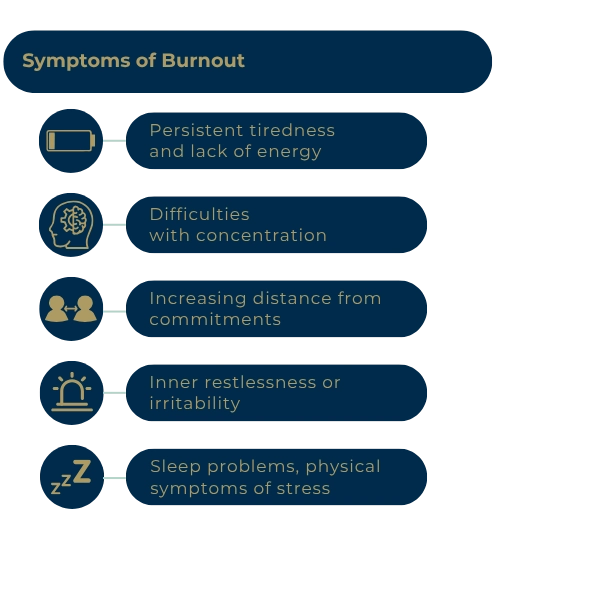
These changes often affect not only one’s professional life but can also have an impact on personal life, social relationships and general well-being.
Life and Work Contexts With an Increased Risk
In principle, anyone can develop burnout. Personal traits can also play a role. A pronounced tendency towards perfectionism, a strong sense of duty or difficulties in setting boundaries can contribute to stress not being adequately managed over a prolonged period.
Furthermore, certain life situations or professional roles are more frequently associated with high levels of stress. These include, amongst others, roles involving significant responsibility for other people or consistently high performance demands. Managers, the self-employed, or people with a strong personal commitment to their work may also be at increased risk.
Please contact us to receive a professional and expert assessment.
Depression – Clinical Picture and Psychological Effects
The depression is one of the most common mental health conditions worldwide and can affect people at different stages of life. Unlike short-term low mood, it is a serious condition that can have a lasting impact on a person’s thoughts, feelings and behaviour. The effects often extend far beyond mood. Many people affected experience changes in their motivation, energy levels and perception of their own life situation. Without appropriate treatment, depressive episodes can persist for a long time and significantly impair everyday life.
Depression as a Medically Recognised Condition
Depression is a clearly defined clinical condition within psychiatric diagnostics. It is diagnosed on the basis of specific criteria, which take into account, amongst other things, the duration, intensity and combination of symptoms.
Unlike burnout, which is usually linked to specific stresses in the workplace, depression can have many different causes. These include biological factors, personal life events and long-term psychological stress. In many cases, several factors interact. This is precisely why a medical assessment is important in order to carefully evaluate the individual’s situation.
Key Symptoms and Changes in Experience and Behaviour
Depression manifests itself through a wide range of possible symptoms, which can affect both the emotional and physical spheres. The symptoms often develop over a prolonged period and noticeably alter the daily lives of those affected.
Typical signs may include, for example:
- Persistently low mood
Many of those affected experience a deep sense of despondency lasting for weeks or months.
- Loss of interest and enjoyment
Activities that were previously found to be rewarding may become increasingly unimportant.
- Reduced drive
Even everyday tasks can seem very burdensome or almost impossible to manage.
- Changes in sleep and concentration
Sleep disturbances, ruminating thoughts or problems concentrating are common.
Not everyone experiences all symptoms to the same extent. The severity can vary greatly from person to person.
Depression and Stress – Possible Links
Stressful life situations or prolonged stress can contribute to the development of depression. These include, for example, excessive demands at work, conflicts in one’s social circle or major life events. At the same time, depression is usually not caused by a single trigger. Often, several biological, psychological and social factors interact.
So-called Exhaustion-related Depression and Its Classification
The term ‘exhaustion depression’ is often used when a depressive disorder arises in connection with long-term overwork. Medically speaking, however, this is not a distinct diagnosis in its own right. Rather, the term describes a depressive condition in which persistent stress plays a significant role. In such cases in particular, it can be difficult to distinguish it from burnout.
A Direct Comparison of Burnout and Depression
Burnout and depression share similar symptoms in some areas. Nevertheless, the two conditions differ in key respects, such as their causes, the development of symptoms and the course of the condition. A close examination of these differences helps individuals to better understand their own situation and plan appropriate therapeutic steps. A clear distinction can be particularly helpful in the early stages to ensure the right support is found.
Differences in Causes and Development
A key difference between burnout and depression often lies in the underlying triggers. Burnout usually develops in connection with long-term stress in the workplace. High demands, a constant sense of responsibility or a lack of rest periods can lead to increasing strain over a prolonged period.
With depression, the development is often more complex. In addition to stressful life situations, biological factors, personal history or genetic influences can also play a role. In some cases, depression occurs without any clearly identifiable external cause.
Find out more about mental health conditions on our blog.
Distinguishing Between Mental and Physical Symptoms
There are also differences between burnout and depression in terms of symptoms. Whilst some symptoms are similar, other aspects differ significantly.
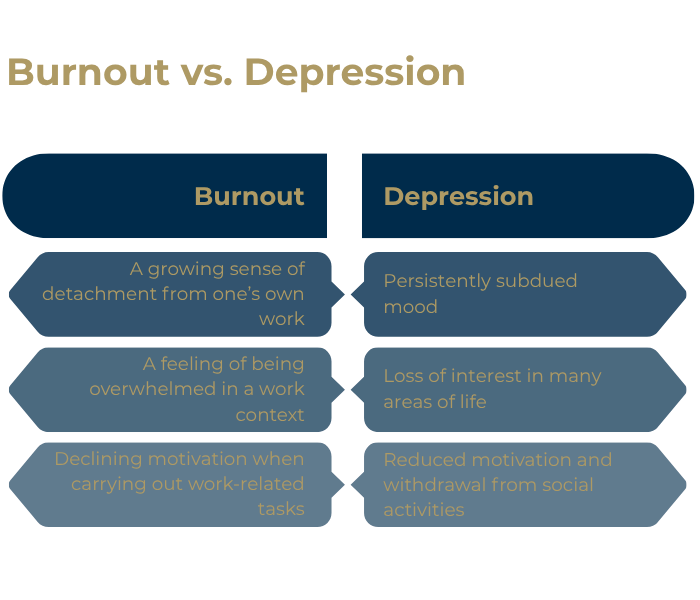
However, these differences are not always clear-cut. Symptoms can overlap, particularly in advanced stages.
Transitions Between Burnout and Depression
In some cases, burnout can develop into depression as it progresses. This usually does not happen suddenly, but rather over several stages. If high levels of stress persist for a prolonged period and there are insufficient periods of rest, the mental health situation can gradually worsen.
A possible course of events might, for example, unfold as follows:
- Persistent stress in everyday life
Constant work demands, high pressure to perform or a lack of time to relax lead to increasing mental strain. Early warning signs such as tiredness or problems concentrating begin to appear.
- Increasing emotional detachment and exhaustion
Those affected increasingly find their work or commitments a burden. Motivation and commitment wane, whilst a sense of inner exhaustion grows.
- Spread of symptoms to other areas of life
The stress is no longer confined to the workplace. Withdrawal from social contact, sleep problems or persistent low mood may also develop.
- Development of depressive symptoms
In this phase, typical signs of depression may appear, such as a persistent low mood, significantly reduced drive or a loss of interest in areas of life that were previously important.
This possible progression highlights how important it is to look out for warning signs at an early stage. A professional assessment can help to identify stress-related issues in good time and initiate appropriate treatment.
Treatment Options for Depression or Burnout at the Limes Schlossklinik Bergisches Land
The treatment of depression or burnout generally requires a holistic and individually tailored therapeutic approach. At the LIMES Schlossklinik Bergisches Land , a personalised treatment plan is therefore drawn up for each patient, based on a comprehensive psychiatric, psychological and psychosomatic assessment.
An interdisciplinary team comprising medical specialists, psychotherapists and specialist therapists then uses this as a basis to develop a treatment plan that combines various medical, psychotherapeutic and supportive measures. The aim is both to understand the causes of the symptoms and to develop sustainable strategies for coping with stress.
The clinic’s core therapeutic components include, amongst others:
- High-frequency psychotherapy
A key component of treatment is intensive psychotherapeutic support. This takes place both in one-to-one sessions and in small group settings. During therapy, personal stressors, internal conflicts and individual behavioural patterns are addressed. At the same time, strategies are developed to better cope with future stressful situations and to strengthen mental stability in the long term. This is supplemented by psychoeducational programmes and neuropsychological interventions.
- Medication
In certain cases, medication may be appropriate, for example in cases of severe depressive symptoms or significant sleep disturbances. Medication is prescribed only following a thorough diagnosis and in accordance with current medical guidelines. It is closely monitored by specialist doctors and tailored to each individual’s specific situation.
- Somatic Medicine
Mental health conditions are often closely linked to physical symptoms. For this reason, treatment also includes comprehensive medical diagnostics. This encompasses, amongst other things, internal medicine examinations as well as laboratory and imaging diagnostics, which are carried out in collaboration with external partners and consultant doctors. This enables physical factors to be identified and integrated into the treatment.
- LIMES Sports.Care (sports therapy programme)
Exercise is an important part of the treatment of stress-related and depressive disorders. With the LIMES Sports.Care programme, the clinic offers a scientifically based training programme that is individually tailored to patients’ physical fitness levels and therapeutic goals. Physical activity can help reduce stress hormones, improve well-being and strengthen mental stability.
- Adjuvant therapies
In addition to medical and psychotherapeutic treatment, the clinic offers a wide range of supportive therapies. These include, amongst others, physiotherapy, art therapy, occupational and exercise therapy, as well as relaxation and mindfulness programmes. These methods can help to reduce stress, process emotional experiences and develop new coping strategies for everyday life.
By combining these various therapeutic approaches, the LIMES Schlossklinik Bergisches Land pursues a holistic treatment approach. The aim is not only to alleviate acute symptoms, but also to support patients in the long term as they regain greater stability, quality of life and inner balance.
FAQ
Can Burnout Develop Into Depression?
Yes, in some cases, burnout can develop into depression as the condition progresses. If severe stress persists over a prolonged period and warning signs are ignored, the symptoms can worsen. Whilst burnout often initially relates to the workplace, depression can eventually affect several areas of life. An early assessment can help to identify this development in good time.
How Can You Tell If Depression Is the Underlying Cause of Persistent Exhaustion?
An important distinguishing feature is that depression is usually not limited to just one area of stress. Alongside persistent tiredness, other symptoms may occur, such as a persistently low mood, loss of interest, social withdrawal or a marked reduction in drive. If such changes persist for several weeks and noticeably interfere with daily life, a medical assessment should be sought.
When Is It Advisable to Seek Professional Support for Burnout or Depression?
Professional support is advisable if mental health symptoms persist over a longer period or become increasingly severe. Even if sleep problems, severe exhaustion, difficulty concentrating or emotional distress significantly affect daily life, a medical or psychotherapeutic assessment can be helpful.
Kategorien: Burnout Depression