Performance Pressure and Self-Esteem – The Psychological Consequences of Modern Working Environments
Table of Contents
Performance Pressure in the Modern Workplace – Causes and Dynamics
1.1 Changes in Work Culture and Rising Expectations
1.2 External and Internal Pressure to Perform
1.3 Competition and Comparison as Intensifying Factors
1.4 The Impact of Digitalisation and Constant Availability
Self-Esteem and Performance Pressure: A Delicate Interplay
2.1 The Link Between Self-Esteem and Performance
2.2 Low Self-Esteem Despite Success
2.3 Perfectionism as a Risk Factor
Psychological Consequences of Constant Pressure to Perform
3.1 Psychological Pressure and Emotional Exhaustion
3.2 Burnout and Depressive Symptoms
3.3 Anxiety Disorders and Inner Restlessness
3.4 Effects on Relationships and Quality of Life
3.5 Physical Symptoms as Warning Signs
Recognising Warning Signs: When Does Performance Pressure Make You Ill?
4.1 Early Signs of Being Overwhelmed
4.2 Changes in Thinking and Behaviour
Treatment Options for Performance Pressure at the LIMES Schlossklinik Bergisches Land
6.1 How Can I Tell If the Pressure to Perform I’m Feeling Is Unhealthy?
6.2 Can Low Self-Esteem Persist Despite Professional Success?
6.3 What Are the First Steps to Help Reduce the Pressure to Perform?
Performance Pressure in the Modern Workplace – Causes and Dynamics
Pressure to perform is no longer a marginal phenomenon in the modern workplace, but a structurally embedded feature of many professional contexts. In demanding roles in particular, a tension arises between high external expectations and internal self-imposed standards. To better understand the psychological consequences, it is worth taking a nuanced look at the key causes and dynamics.
Changes in Work Culture and Rising Expectations
Work culture has undergone fundamental changes in recent years. Rigid hierarchies and clearly defined areas of responsibility are increasingly being replaced by flexible, dynamic structures. Whilst this development opens up new scope for creativity, it is often accompanied by an intensification of demands.
The most significant changes include, in particular:
- Increasing personal responsibility
Decisions are increasingly being taken at a local level, which means employees are taking on greater responsibility.
- Higher expectations regarding self-improvement
Continuous professional development and personal growth are often taken for granted.
- The blurring of the boundaries between work and private life
Workplace demands are encroaching more heavily on private life, making it harder to draw a line between the two.
- Increasing complexity and the volume of decisions
Tasks are becoming more multifaceted; decisions must be made more frequently and under greater time pressure, which further increases the perceived pressure to perform.
These factors contribute to the fact that pressure to perform is no longer experienced on a situational basis, but is often felt on a permanent basis.
External and Internal Pressure to Perform
Performance pressure rarely arises solely from external circumstances. Rather, it is the result of an interplay between external demands and internal beliefs. External performance pressure arises, for example, from clearly defined targets, economic conditions or the expectations of line managers and business partners. In performance-oriented organisations, success is often made measurable, which further intensifies the pressure.
In contrast, there is internal pressure to perform, which is often less visible but no less potent. It stems from personal expectations, the desire for control and the need to meet expectations – both one’s own and those of others. Particularly in the case of ambitious individuals, this inner drive can lead to chronic self-imposed pressure, even without external constraints necessarily being the primary factor.
Competition and Comparison as Intensifying Factors
In many sectors, competition is a central component of corporate culture. Performance is not viewed in isolation, but is often assessed in direct comparison with others.
This comparison takes place at various levels:
- within teams or organisations
- in the market environment and in relation to competitors
- increasingly also in the digital sphere
Particularly in positions of responsibility, this constant comparison can lead to latent tension. It encourages a tendency to link one’s self-worth strongly to measurable successes. If these fail to materialise or do not meet one’s own expectations, this can noticeably undermine self-esteem.
The Impact of Digitalisation and Constant Availability
Digitalisation has made the world of work more efficient and faster – but at the same time it has increasingly blurred the boundaries between work and leisure. Mobile devices and digital communication channels enable people to be reachable almost around the clock.
Typical effects include:
- Acceleration of work processes
Decisions and responses are expected within ever shorter timeframes.
- Reduced recovery periods
Even outside traditional working hours, a mental or actual connection to work-related matters persists.
- A sense of constant availability
The expectation of being able to respond at any time continuously increases psychological pressure.
In the long term, this development can mean that periods of respite are lacking. Pressure to perform thus becomes a chronic condition that can have a lasting impact on both mental well-being and self-esteem.
Self-esteem and Performance Pressure: a Delicate Interplay
Performance pressure not only affects behaviour but also has a profound impact on a person’s self-image. Particularly in performance-oriented environments, a close link often develops between professional success and personal self-esteem. This interplay can have a stabilising effect – but it also harbours considerable risks if one’s own worth becomes increasingly tied to performance.
The Link Between Self-esteem and Performance
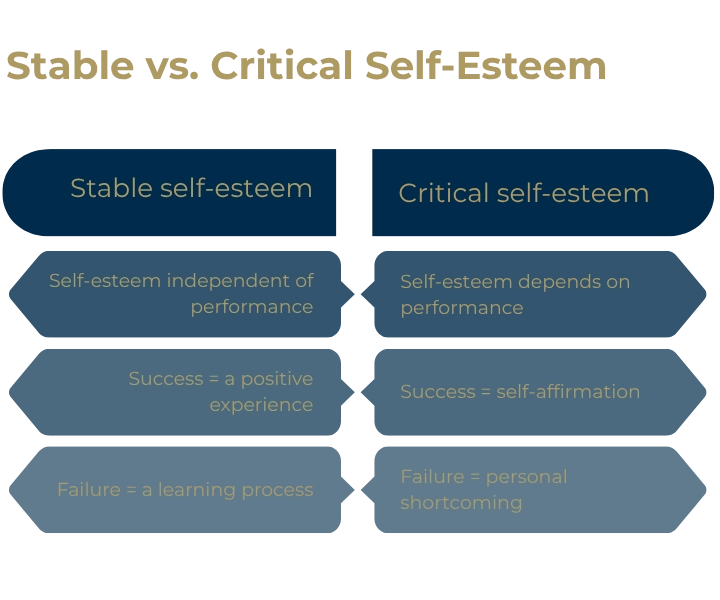
In many professional contexts, performance is used as a key yardstick for recognition and appreciation. This can lead to one’s sense of self-worth being increasingly defined by achieved goals, positions or results.
However, such performance-based self-worth is susceptible to fluctuations. If successes fail to materialise or do not meet one’s own expectations, this can lead directly to self-doubt. Conversely, success is often experienced as validation only in the short term, before new demands – and with them new pressure to perform – arise.
In the long term, this creates a cycle in which performance becomes a prerequisite for self-worth – rather than an expression of it.
Find out more now about the LIMES Schlossklinik Bergisches Land.
Low Self-esteem Despite Success
It is striking that even objectively successful people do not necessarily possess stable self-esteem. On the contrary: particularly in demanding roles, there is often a discrepancy between external success and inner experience.
Typical internal patterns may include:
- Downplaying one’s own achievements
Successes are taken for granted, regarded as expected, or attributed to external circumstances.
- Fear of being exposed
There is a subliminal worry that one will not be able to live up to one’s own standards in the long term or that one will be perceived as ‘not good enough’.
- Focus on shortcomings
Attention is primarily directed towards mistakes, oversights or areas for improvement, whilst successes lose their significance.
- Limited lasting impact of experiences of success
Positive results lead to satisfaction only in the short term and quickly lose their emotional relevance.
These ways of thinking mean that even achieved goals do not contribute to a stable sense of inner security. Instead, a feeling of latent insecurity persists, which can further intensify the pressure to perform.
Perfectionism as a Risk Factor
In many professional contexts, perfectionism is closely linked to a willingness to perform and is often viewed positively. However, the degree to which it is manifested is crucial. Whilst functional perfectionism can contribute to a structured and meticulous approach to work, an excessive form often leads to persistent inner tension. Standards are set so high that they are virtually unattainable.
What is characteristic here is not so much the pursuit of quality, but rather the nature of self-assessment:
- Mistakes are not seen as part of a process, but as personal failure.
- Results are only considered acceptable if they are virtually flawless.
- Satisfaction rarely sets in, as the focus immediately shifts to the next area for improvement.
The result is a state in which performance is consistently delivered, yet provides little sense of relief. Instead, psychological pressure intensifies, whilst self-worth becomes increasingly tied to unattainable ideals.
Psychological Consequences of Constant Pressure to Perform
Constant pressure to perform rarely goes without consequences. What begins as heightened tension can gradually develop into widespread psychological strain. It is not just individual symptoms that are relevant here, but above all the dynamics by which these intensify and become entrenched in everyday life.
Psychological Pressure and Emotional Exhaustion
Persistent psychological pressure often leads to a state in which inner tension becomes the norm. Although time is set aside for rest, it no longer has the desired effect. A typical feature is a gradual shift in one’s own perception: tasks that were once handled routinely now seem increasingly burdensome. At the same time, the ability to mentally distance oneself diminishes. A feeling of constant ‘inner activity’ arises, even during quiet moments. This form of exhaustion often goes unrecognised for a long time, as it develops gradually rather than abruptly.
Burnout and Depressive Symptoms
If this condition persists, it can lead to burnout. Unlike mere overwork, this is a more profound state of exhaustion that affects both emotional and cognitive processes. In addition, depressive symptoms, which manifest themselves through the following changes, amongst others:
- Significantly reduced motivation
Even everyday tasks require a disproportionate amount of effort.
- Loss of interest
Activities that were previously experienced as meaningful or fulfilling lose their significance.
- Inner emptiness or indifference
Emotional responses become blunted; both positive and negative feelings are perceived with less intensity.
- Self-doubt of increasing intensity
One’s own ability to perform and personal stability are called into question.
These developments often occur in parallel and reinforce one another.
Anxiety Disorders and Inner Restlessness
Alongside states of exhaustion, forms of anxiety and inner restlessness often arise when under constant pressure to perform. These do not always manifest as clearly recognisable anxiety disorder, but are often more subtle.
Typical signs may include:
- A constant feeling of tension without any clear trigger
- Mentally anticipating negative outcomes
- Difficulty finding peace of mind, even in relaxed situations
- Increased sensitivity to criticism or judgement
This form of inner restlessness can significantly impair quality of life and often leads to a feeling of loss of control.
Effects on Relationships and Quality of Life
The psychological consequences of performance pressure are not limited to the workplace. They often also affect interpersonal relationships and overall life satisfaction.
In a private context, this can lead to a tendency to withdraw, as emotional and time resources are limited. Conversations are perceived as exhausting, and social contacts either diminish or lose their quality.
Furthermore, one’s perception of one’s own life may change: activities that were previously experienced as enriching fade into the background. The ability to feel contentment or a sense of balance diminishes noticeably.
Physical Symptoms as Warning Signs
Psychological stress often manifests itself physically as well. These signals should be taken seriously, as they frequently indicate stress at an early stage.
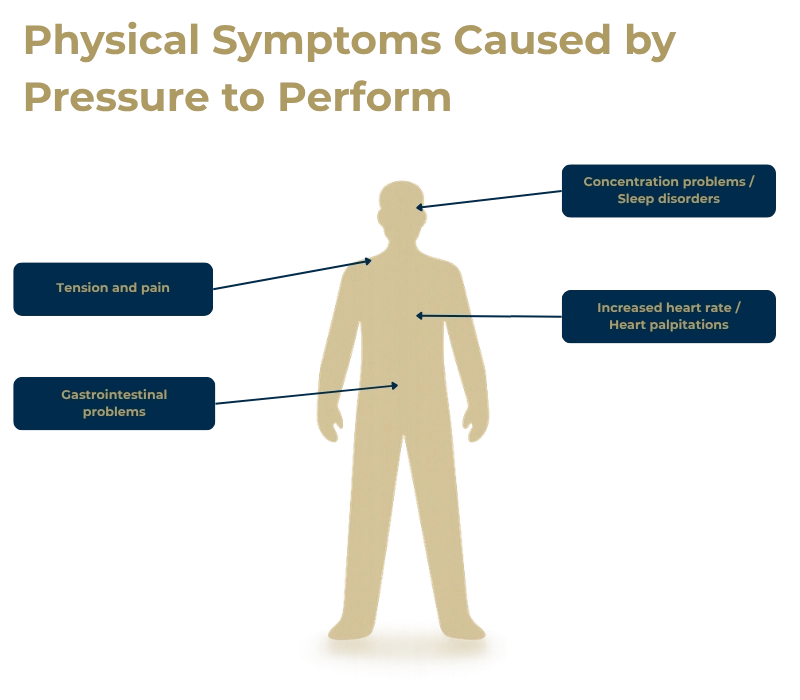
These physical reactions are not an isolated problem, but rather an expression of ongoing psychological stress that should not be ignored.
Find out now how somatoform disorders are treated at the LIMES Schlossklinik Bergisches Land.
Recognising Warning Signs: When Does Performance Pressure Make You Ill?
Pressure to perform is often only recognised as a problem once the stress has already become quite severe. Early warning signs are often subtle and are easily overlooked or rationalised in everyday life. This makes it all the more important to be aware of these changes and to interpret them correctly.
Early Signs of Being Overwhelmed
The first indications of being overwhelmed rarely manifest as clearly defined symptoms. Rather, they take the form of gradual changes in one’s own experience and in one’s daily resilience.
Typical early signs include:
- Changes in the perception of physical exertion
Tasks that were previously easy to manage are increasingly perceived as strenuous or unpleasant.
- Increased preoccupation with work
Work-related issues remain at the forefront of one’s mind even outside working hours and are difficult to put aside.
- Reduced ability to recover
Breaks or days off no longer lead to any noticeable recovery.
- Mild irritability in everyday life
Even minor disruptions or unexpected demands trigger disproportionate reactions.
Not every one of these signs is problematic in itself. What matters more is the duration and frequency with which these changes occur.
Changes in Thinking and Behaviour
As stress levels increase, it is not only one’s emotional state that changes, but also patterns of thought and behaviour. These changes are often less obvious, yet they have a significant impact on everyday life.
The following tendencies often become apparent in thinking:
- Greater focus on potential mistakes or risks
- Reduced ability to assess situations in a nuanced way
- Increasing tendency towards black-and-white thinking regarding performance and success
Behavioural changes often manifest themselves differently. Some people affected tend to withdraw further, whilst others respond by working even harder. Both strategies can have a stabilising effect in the short term, but in the long term they contribute to increasing the stress.
Furthermore, warning signs are often actively ignored. One’s own limits are no longer used as a guide, but are perceived as an obstacle to be overcome. It is precisely at this point that performance pressure begins to evolve from a challenge into a health risk.
Treatment Options for Performance Pressure at the Limes Schlossklinik Bergisches Land
The treatment of performance pressure and impaired self-esteem requires a personalised, holistic approach. At the LIMES Schlossklinik Bergisches Land , various therapeutic approaches are available to you, which focus both on the psychological causes and on fostering the development of healthy self-esteem.
In this context, the following treatment components are used in particular:
- High-frequency psychotherapy
In intensive one-to-one sessions, stressful thought patterns, performance-related self-assessments and internal drivers are specifically addressed. The aim is to develop a more stable self-image and to bring about lasting change to dysfunctional performance expectations.
- Intensive psychotherapeutic support in individual and group settings
The combination of individual and group therapy enables clients to explore personal issues in depth whilst simultaneously gaining new perspectives through interaction with others. This can be particularly helpful in recognising and contextualising one’s own patterns when under pressure to perform.
- Psychoeducation on various disorders
A sound understanding of one’s own sources of stress is a central component of the treatment. You will gain insights into the mechanisms of psychological pressure, exhaustion and self-esteem dynamics, which makes it easier to manage your own symptoms.
- Relaxation therapy and mindfulness-based techniques
Methods such as breathing exercises, mindfulness or progressive muscle relaxation help to specifically reduce inner tension. They promote the ability to gain some distance and return to a balanced state.
- Art and movement therapy
Creative and body-oriented forms of therapy provide access to emotional processes that cannot always be expressed through language. At the same time, they foster a sense of self-efficacy beyond the realm of performance.
- The healing environment as a therapeutic framework
The clinic’s unique environment – characterised by its architecture, natural surroundings and tranquillity – actively contributes to stabilisation. It helps patients to distance themselves from the stresses of everyday life and to focus on their own recovery process.
Combining these approaches results in a personalised treatment plan not only reduces symptoms but also helps, in the long term, to develop a healthier way of coping with performance pressure and a more stable sense of self-esteem.
Contact us now to receive help tailored to your individual situation.
FAQ
How Can I Tell If the Pressure to Perform I’m Feeling Is Unhealthy?
Unhealthy performance pressure is less evident in individual stressful situations and more so in the fact that you are no longer able to relax. If work-related issues remain constantly on your mind and you are unable to switch off even in your free time, this is a clear warning sign. Persistent tension, declining concentration or increasing irritability can also indicate that you have exceeded your stress threshold. The situation becomes particularly critical when this state persists over a long period and no longer resolves itself.
Can Low Self-esteem Persist Despite Professional Success?
Yes, low self-esteem can exist regardless of external success. In many cases, a discrepancy arises between one’s objective performance and one’s inner experience. Successes are often put into perspective or quickly lose their significance, whilst the focus remains on potential weaknesses or future demands. This can create the impression that one is permanently failing to live up to one’s own expectations.
What Are the First Steps to Help Reduce the Pressure to Perform?
An important first step is to consciously recognise one’s own stress levels and not to downplay them too hastily. Pressure to perform is often interpreted as a normal part of success, which means warning signs are ignored for a long time. It is also helpful to critically examine one’s own expectations and not only to plan for periods of rest but also to actually allow oneself to take them. If you find it difficult to manage the pressure on your own, professional support can be useful in developing sustainable strategies.
Kategorien: Anxiety Disorders Burnout